
Upstream vs. Downstream Packaging Automation: How the Two Systems Interact
1. What This Resource Covers & Why It Matters
Packaging automation investments fail more often from sequencing mistakes than from technology failures — even when manufacturers correctly identify where robots deliver the most automation value on a packaging line. A manufacturer who automates palletizing before fixing upstream product flow variability discovers that the palletizer starves. A manufacturer who installs high-speed vision-guided infeed systems before the downstream case packer can absorb the output builds work-in-process rather than throughput. The upstream and downstream halves of a packaging line are interdependent, and treating them as separate decisions produces predictable problems.
This article compares upstream and downstream packaging automation across the criteria that actually drive sequencing and investment decisions. It is not a technology overview. Both systems are covered in depth in separate articles. This article answers a specific question: when you cannot automate everything at once, which half do you address first, and why does that choice matter?
The audience is operations managers, engineers, and business owners who are evaluating a packaging line investment and need a framework for sequencing that investment correctly.
2. Side-by-Side Comparison
| Decision Criterion | Upstream Automation | Downstream Automation |
|---|---|---|
| Primary function | Converts unstructured product flow into consistent, oriented input for packaging machines | Groups, seals, labels, verifies, and palletizes packaged products for distribution |
| Labor impact | Reduces infeed staffing; eliminates manual orientation and singulation positions | Eliminates palletizing, case packing, and stretch wrapping labor directly |
| ROI driver | OEE recovery on existing packaging machines; changeover speed on multi-SKU lines | Direct labor replacement; injury risk reduction; quality verification compliance |
| Typical entry cost | $50,000–$200,000 depending on vision, robotics, and conveyor scope | $65,000–$400,000 depending on palletizing tier and line integration |
| Payback timeline | 18–36 months; depends on packaging machine OEE recovery | 12–24 months at two-shift palletizing; longer for full downstream sequences |
| Flexibility requirement | High; upstream must handle product mix variation and changeovers | Moderate; downstream handles carton and pallet variation but product is already packaged |
| Failure consequence | Downstream packaging machine starves; throughput drops | Pallet output drops; product accumulates before palletizer; labor gap reappears |
| Maintenance complexity | Vision system calibration; gripper wear; conveyor spacing | Stretch film management; palletizer EOAT; sealer adjustment across carton formats |
| Integration dependency | Must match packaging machine cycle time precisely | Must match upstream case output rate; pallet flow must connect to stretch wrapper |
| Where bottleneck shows | Packaging machine runs below OEE due to infeed stops | Cases accumulate before palletizer; manual labor fills gap at end of line |
3. When Each Approach Makes Sense
Start Upstream When the Packaging Machine Is Underperforming
If a packaging machine is running below 75% OEE and stop event logs show that infeed variability is the root cause of the bottleneck, upstream automation delivers return without buying new equipment. The machine is already capitalized. Stabilizing product flow to it recovers throughput from an asset already on the floor. In practice, this is the highest-return scenario in packaging automation because the investment is relatively modest and the return appears immediately in machine uptime.
Start Downstream When Labor Is the Documented Constraint
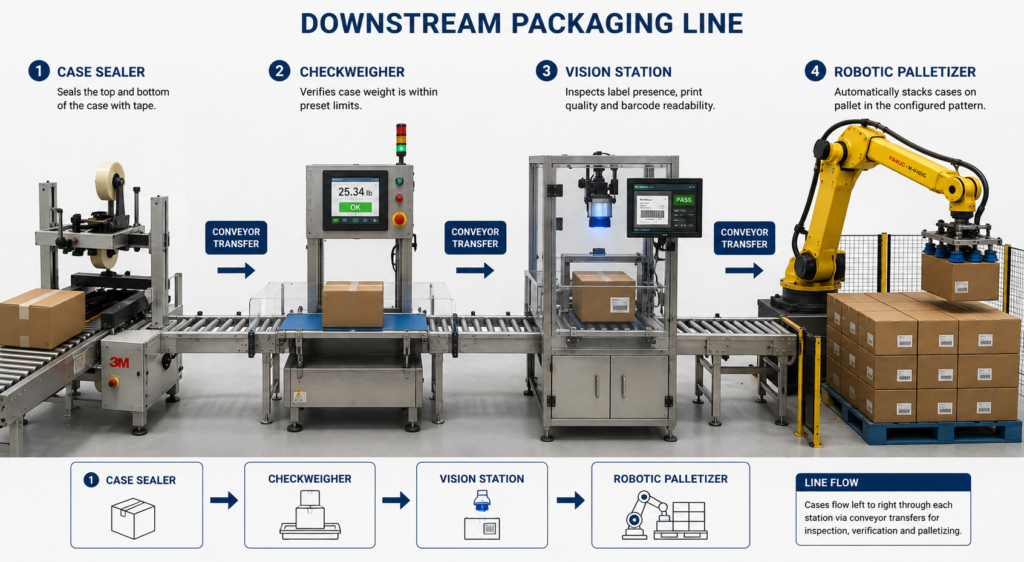
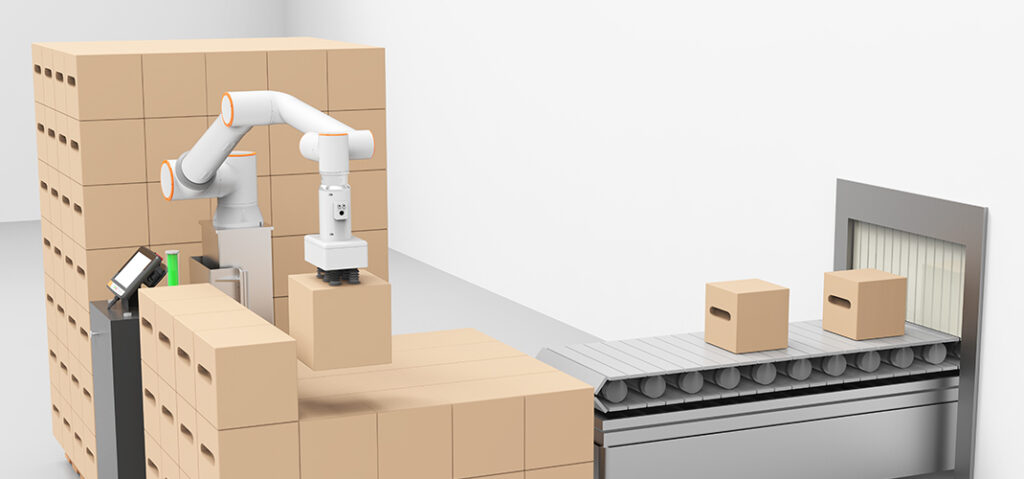
If the packaging machine runs well and cases accumulate at the end of the line because palletizing or robotic case packing cannot keep pace, downstream automation addresses the actual constraint. Robotic palletizing is typically the first downstream investment because the ROI math is straightforward. A two-shift palletizing position costs $110,000 to $150,000 annually. A cobot palletizing system costs $65,000 to $100,000 installed. Payback arrives before 18 months in most operations. Beyond that, injury exposure at palletizing stations adds a risk-reduction argument that stands independently of labor savings.
Address Upstream First When SKU Mix Is High
Operations running more than five product variants per shift face a different upstream challenge than high-volume single-SKU lines. Vision-guided robotic handling that switches by program rather than mechanical adjustment reduces changeover time from 30 to 90 minutes to under 10 minutes per switch. In high-mix environments, that changeover recovery across a week of production often exceeds the throughput value of any downstream improvement. For that reason, multi-SKU operations frequently find upstream investment pays back faster than the labor math alone suggests.
Address Downstream First When Compliance Requires Verification
Regulated manufacturers in pharmaceutical, food, and medical device environments often have a compliance-driven case for downstream automation that bypasses the throughput calculation entirely. Per-case weight verification, vision-confirmed label placement, and serialized traceability records are regulatory requirements in many of these environments. Automating downstream verification is not optional when regulations mandate it. In those contexts, the downstream investment is justified before the labor case is even built.
4. Real-World Cost and ROI
Upstream automation entry costs range from $50,000 for a singulation conveyor and accumulation buffer to over $200,000 for a full vision-guided robotic pick-and-place cell with multiple EOAT configurations. The return on upstream investment appears in OEE points recovered on the downstream packaging machine. A machine valued at $500,000 running at 65% OEE instead of 85% OEE represents a significant throughput gap. Recovering those 20 OEE points through upstream stabilization produces a return that the machine’s capital cost makes obvious.
Downstream automation costs range from $65,000 for a cobot palletizing cell to $400,000 or more for a fully integrated sequence covering case packing, sealing, labeling, vision verification, robotic palletizing, and stretch wrapping. The labor return on downstream investment is more direct and easier to present to finance. However, integration cost, including conveyors, safety systems, and facility preparation, frequently adds 20 to 40% to the equipment cost. Get integration scoped before the business case is submitted.
5. Integration Considerations
Upstream automation connects to the packaging machine’s infeed and must synchronize with the machine’s cycle time precisely. If the upstream robot or conveyor delivers product faster than the packaging machine cycles, product accumulates at the infeed and jams. If it delivers slower, the machine starves. This timing relationship requires encoder-based conveyor tracking and confirmed communication between the upstream system’s PLC and the packaging machine controller. Validate this interface at actual production speed before commissioning sign-off.
Downstream automation connects to upstream case output and must match that rate across the full shift, not just at peak speed. A palletizer sized for 12 cases per minute that receives 15 cases per minute during production bursts creates accumulation that eventually stops the line. Beyond rate matching, the pallet flow from palletizer to stretch wrapper to outbound staging must be planned as a continuous sequence. Manual handling gaps between automated stations reintroduce the labor the automation was installed to eliminate.
Staffing changes differently in each half. Upstream automation typically redeploys infeed operators to quality monitoring or material handling roles rather than eliminating positions entirely. Downstream automation more directly reduces headcount at palletizing and case packing stations, which requires HR planning alongside the engineering scope.
6. Common Mistakes When Choosing
The most common mistake is automating downstream before fixing upstream variability. A robotic palletizer receiving cases at inconsistent rates due to upstream infeed problems runs below its rated throughput and produces a weaker ROI than projected. The packaging machine is still underperforming. The palletizer is underutilized. Both investments underdeliver because the root cause was never addressed.
A second mistake is sizing downstream automation to the packaging machine’s nameplate speed rather than its actual cases-per-minute output rate measured across a full shift. A packaging machine rated for 200 cases per hour that actually produces 140 cases per hour due to changeovers and stops does not need a palletizer sized for 200. Specifying to nameplate capacity adds cost without adding return and creates a palletizer that runs at 70% of its rated speed from day one.
Operations also frequently underestimate integration cost by evaluating equipment cost alone. The conveyors connecting a palletizer to a stretch wrapper, the safety fencing around a robot cell, and the electrical service upgrade for a new downstream sequence all carry real cost that does not appear in an equipment quote. Projects that discover integration scope during installation face change orders that shift payback timelines significantly. Scope the full installation before submitting a capital request.
7. Key Questions Before Committing
- Have you mapped stop events on the packaging machine and confirmed whether upstream infeed variability or downstream accumulation is the primary constraint, and does the data support the investment you are about to make?
- What is the actual cases-per-hour output of the packaging machine measured across a full shift including changeovers and stops, and is the downstream automation you are specifying sized to that actual rate rather than the nameplate speed?
- What is the full integration scope for the proposed investment, including conveyors, safety systems, PLC communication interfaces, and facility preparation, and has that scope been priced by the integrator in writing before the capital request was submitted?
- If automating downstream, what happens to the upstream infeed staffing, and has HR been included in the project plan to address the redeployment or transition of those positions?
- If automating upstream, have you confirmed that the packaging machine’s PLC supports the communication protocol the upstream system requires, and has that interface been validated at production speed rather than at a reduced commissioning rate?
8. How RBTX Learn Recommends Using This Information
RBTX Learn recommends treating upstream and downstream packaging automation as a sequenced program rather than two competing investments. Start by identifying where the documented bottleneck actually lives. If the packaging machine is underperforming due to infeed variability, upstream automation recovers throughput from existing equipment at lower cost than adding capacity downstream. If the packaging machine is running well and cases are accumulating at the end of the line, downstream automation addresses the actual constraint.
For detailed coverage of each half, RBTX Learn has published dedicated articles on upstream packaging automation and downstream packaging automation. Each covers the specific equipment, integration requirements, failure modes, and ROI frameworks for its respective stage. This article provides the sequencing logic. Those articles provide the implementation depth.
The right sequence is always determined by where the constraint lives today, not by which investment is easier to justify or which equipment is more visible on the production floor. RBTX Learn recommends mapping the full line, documenting stop events and throughput gaps across both stages, and letting that data determine which investment goes first. Operations that follow the data rather than the instinct make fewer sequencing mistakes and produce stronger returns on both investments.