
Robotic Case Packing Systems: How Robots Automate Secondary Packaging
1. What This Resource Covers & Why It Matters
Case packing sits between primary packaging and palletizing, and it is one of the most consistently manual steps where packaging automation delivers measurable ROI. Once products leave filling machines, assembly lines, or form-fill-seal systems, someone has to group them and load them into shipping cartons. At moderate line speeds that job is manageable. At high speeds or with frequent product changeovers, it becomes a packaging bottleneck that limits the entire system.
Manual case packing limits throughput in two ways. First, workers cannot sustain pace with fast upstream equipment across a full shift without fatigue-driven slowdowns. Second, manual stacking introduces orientation errors that cause problems at the press brake downstream or, in food and pharma environments, trigger compliance failures at inspection. The ergonomic cost is also real. Repetitive lifting and twisting at a case packing station generates injury claims that compound over time.
Robotic case packing automates product placement using industrial robots with specialized end-of-arm tooling. These systems operate at defined cases-per-minute rates continuously, adapt to multiple product formats through program changes rather than mechanical changeovers, and keep downstream sealing and palletizing equipment from starving. This article covers what that equipment actually looks like, how it integrates, where it fails, and when the investment makes sense.
2. Typical Equipment in This System
| Equipment | Role or Typical Capability |
|---|---|
| 6-axis industrial robot or delta robot | Performs pick-and-place operations; delta robots suit high-speed light-product applications; 6-axis handles heavier or complex orientation requirements |
| End-of-arm tooling (EOAT) | Vacuum cups for cartons and pouches; mechanical grippers for rigid products; multi-pick tooling lifts entire product groupings in a single motion |
| Product infeed conveyor | Delivers products from upstream at consistent spacing; spacing consistency directly determines pick reliability |
| Vision system | Identifies product position and orientation on the conveyor in real time; allows the robot to pick randomly presented products without mechanical orienting equipment |
| Case erector | Forms flat blanks into open cartons and presents them to the indexing conveyor; eliminates manual box building upstream of the robot |
| Case indexing conveyor | Positions open cartons at the robot’s load point; indexes forward after each fill cycle to present the next empty case |
| PLC or robot controller | Synchronizes robot pick timing with conveyor speed, case indexing, and upstream line signals; manages fault response and changeover logic |
| Case sealer (downstream) | Closes and tapes or glues filled cartons as they exit the robotic cell; must be sized to match the robotic cell’s output rate |
The case sealer, conveyors, palletizer, and stretch wrapper that follow the robotic cell are covered in detail in our guide to automation applications in downstream packaging operations.
3. How It Works: Real-World Breakdown
Single-Pick and Multi-Pick Strategies
The simplest robotic case packing configuration picks one product at a time from the infeed conveyor and places it into the open carton. Cell architects most often choose between 6-axis articulated arms and high-speed delta robots depending on payload, cycle rate, and product fragility. Single-pick configurations work well for fragile products, heavy items, or applications requiring precise individual placement inside the case. In practice, single-pick throughput is limited by the robot’s cycle time per pick. At high line speeds, a single-pick cell may not keep pace with upstream equipment without a second robot.
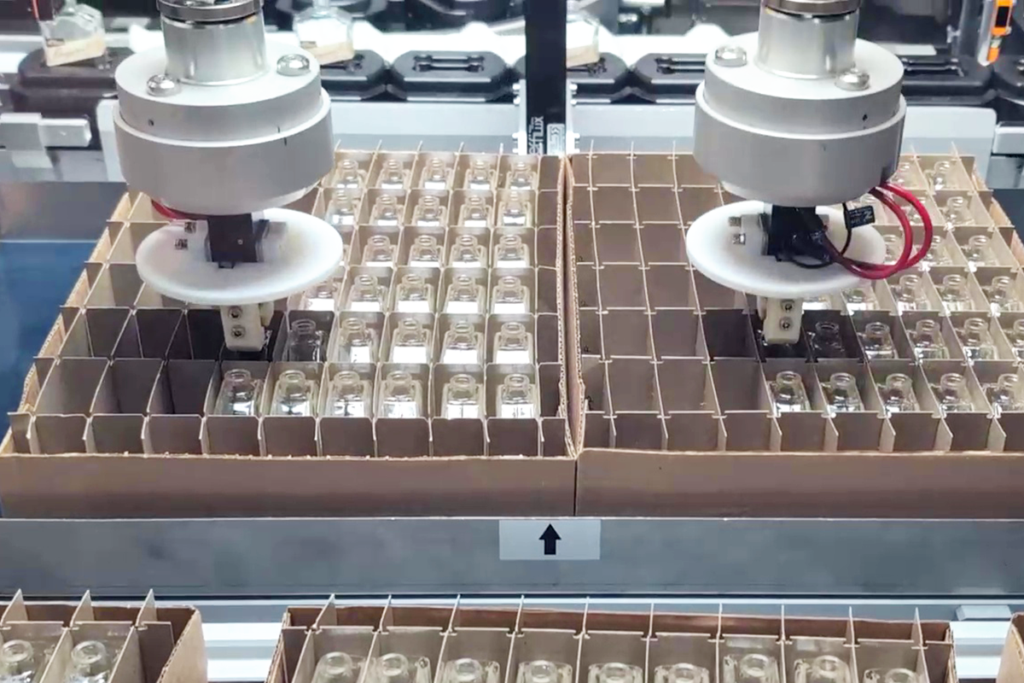
Multi-pick tooling addresses this by lifting an entire product grouping in one motion. A vacuum gripper designed to pick a 2×3 array of pouches, for example, loads six products per cycle rather than six individual picks. As a result, throughput rises substantially without increasing robot speed. Multi-pick tooling requires consistent product spacing on the infeed and a controlled presentation surface. It is the right strategy for operations running high volumes of a consistent product format.
Vision-Guided Picking for Variable Presentation
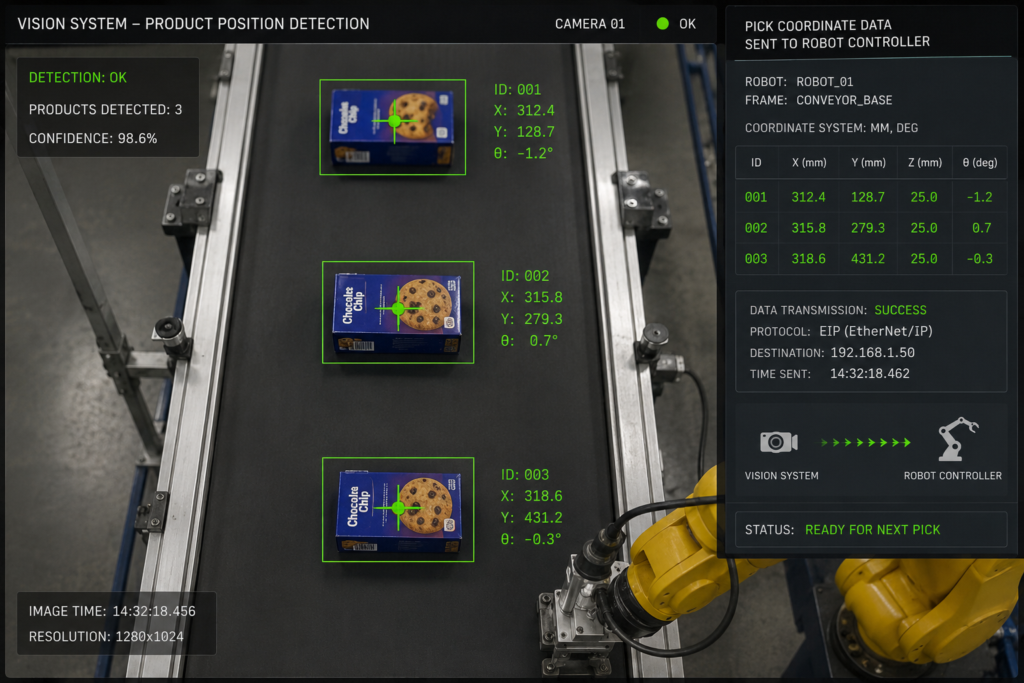
Many packaging environments deliver products to the case packing station in inconsistent orientations. Bottles that have rotated, pouches that have shifted, or parts that arrive in random positions on a flat belt all require the robot to adapt its pick position dynamically. Machine vision systems solve this by capturing a camera image of each product as it passes, calculating the actual position and angle, and sending corrected pick coordinates to the robot controller before the robot executes the pick.
Vision-guided picking adds cost and programming complexity. However, it eliminates the mechanical orienting equipment that would otherwise be required upstream of the robot. In high-mix environments, vision guidance also allows the system to handle multiple product formats without mechanical changeover at the infeed.
Changeover for Multi-SKU Production
Mechanical case packers require physical change parts when product dimensions or case formats change. Changeover time on a mechanical machine often runs 30 to 90 minutes. Robotic systems switch between product programs through operator selection at the HMI, typically in under 10 minutes, with tooling swaps only when product geometry changes significantly.
In practice, this flexibility determines whether a robotic case packer is viable for high-mix, lower-volume production. A line running 15 different SKUs per week cannot absorb 90-minute changeovers at every product switch. A robotic cell that switches in under 10 minutes makes that product mix automatable where a mechanical machine cannot.
4. Integration & Deployment Reality
PLC and line synchronization is the integration task that determines whether the cell runs smoothly or generates constant faults. The robot controller must receive line speed signals from the upstream packaging machine and case index confirmation from the downstream conveyor. If upstream line speed varies, the robot’s pick window changes with it. Confirm that the upstream machine outputs a reliable encoder signal and that the robot controller supports encoder-based conveyor tracking before specifying the system.
Mechanical layout requires defined floor space for the robot’s working envelope, the infeed conveyor, the case indexing conveyor, and the case erector. Delta robots have a compact overhead footprint. Six-axis robots require more lateral clearance. Map the full cell footprint including safety guarding before finalizing placement. Case erectors also require floorspace that many initial layouts undercount. Measure the actual available envelope with the maintenance access doors open, not just the machine’s nominal footprint.
Electrical and safety requirements include 480V three-phase service for industrial robot cells and area scanners or physical fencing depending on the robot type. Collaborative robot case packing cells reduce safety fencing requirements but carry payload and speed limitations that may not suit high-throughput applications. Confirm the safety architecture with the integrator before the risk assessment is complete, not after the cell is on the floor.
Product and carton qualification must happen before commissioning. Run the actual product through the proposed EOAT design with the actual conveyor spacing before signing off on tooling drawings. Products that slip, compress unexpectedly, or present surface variation that defeats vacuum contact generate tooling rework after installation. This is the most common source of go-live delays in robotic case packing projects.
5. Common Failure Modes & Constraints
| Failure | Root Cause | Signal / Symptom |
|---|---|---|
| Missed picks on infeed | Product spacing inconsistent; conveyor speed variation exceeds vision tracking range | Robot reaches for product but misses; increasing fault rate; product accumulates on infeed |
| Vacuum loss mid-pick | Worn suction cups; product surface too porous or wet for vacuum contact | Product drops mid-transfer; carton loaded incorrectly or not at all |
| Case indexing fault | Carton not seated correctly in indexer; case erector producing malformed blanks | Robot places product outside carton; indexing sensor fault alarm |
| Throughput below specification | Multi-pick tooling cycling slower than expected; upstream line running faster than robot qualification rate | Downstream sealer starves intermittently; product accumulates between cell and sealer |
| Changeover takes longer than planned | Program and tooling swap not rehearsed; EOAT quick-change mechanism worn | Line downtime exceeds planned changeover window; production schedule falls behind |
Vacuum cup wear is the highest-frequency maintenance issue in soft-product case packing. Establish a cup replacement schedule based on production cycles rather than calendar time. A cup degrading gradually produces intermittent missed picks before it fails completely. Track miss rate per shift. A rising miss rate before any fault alarm is the reliable early signal that cups need replacement.
Infeed spacing is the integration failure that appears most often after go-live. If the upstream machine delivers products in bursts rather than at uniform intervals, the robot’s pick window varies beyond what the vision system can compensate. Commission the infeed interface at actual production speed, not at a reduced commissioning rate, and require spacing consistency data from the upstream machine before signing off on cell acceptance.
6. When It’s a Good Fit vs. a Bad Fit
Good fit when:
Robotic case packing returns investment most clearly when manual loading is the measured throughput constraint on a line running two or more shifts. Beyond throughput, operations running multiple SKUs on the same line benefit significantly from program-driven changeover rather than mechanical change parts. In food, pharma, and consumer goods environments where documentation of case contents and packing patterns is a compliance requirement, robotic systems generate consistent, auditable records that manual operations cannot reliably produce.
High risk when:
The investment carries elevated risk when the product has not been qualified through the proposed EOAT before the tooling is ordered. Products that seem straightforward on paper, pouches, small cartons, bottles, frequently present surface, weight, or flexibility characteristics that defeat standard vacuum or mechanical grippers. Beyond tooling, risk rises when the upstream machine cannot deliver products at consistent spacing. A robot that cannot pick reliably due to infeed variability will not meet throughput specifications regardless of its nominal cycle time.
Usually the wrong tool when:
Robotic case packing is the wrong investment for products with extreme fragility or geometric complexity that no standard or custom gripper can handle reliably at production speed. It is also the wrong tool when total production volume is low enough that manual packing costs less than the system amortized over its useful life. A single-shift operation running one SKU at 8 cases per minute may find that a well-staffed manual station outperforms the business case for automation. Run the numbers honestly before committing capital.
7. Key Questions Before Committing
- What is the current measured cases-per-minute rate at the manual packing station, how does it compare to the upstream machine’s output rate, and have you calculated the annual cost of that gap in lost throughput and labor?
- Has the proposed end-of-arm tooling design been validated against the actual product, including surface condition, weight distribution, and any moisture or coating that may affect vacuum contact?
- Does the upstream packaging machine deliver products at consistent spacing, and can you provide the robot integrator with actual conveyor spacing data rather than nominal specification data?
- What is the SKU count that will run through this cell, how often does the product change per shift, and has changeover time been included in the throughput model rather than calculated only against single-product runtime?
- Who performs EOAT maintenance, cup replacement, and program updates after commissioning, and has that person been identified and included in the project training plan before go-live?
8. How RBTX Learn Recommends Using This Information
RBTX Learn recommends starting the case packing evaluation with a throughput audit rather than an equipment specification. Measure the actual manual packing rate at production speed across a full shift, not just at the start of a shift when workers are fresh — this is the foundation of cases-per-minute throughput engineering across the entire packaging line. Compare that rate to the upstream machine’s output. The gap between those two numbers is the measurable cost of the bottleneck and the return the automation investment needs to beat. Operations that skip this step frequently specify systems sized to theoretical throughput rather than the actual constraint.
On tooling, treat product qualification as a project phase rather than a vendor assumption. Require the integrator to test the proposed EOAT against actual product samples before tooling drawings are finalized. This step adds time at the front of the project and eliminates the most common source of commissioning delays and post-installation rework. No product surface behaves exactly the way it appears on a datasheet.
RBTX Learn also recommends mapping the full case packing cell into the production line before the capital request is submitted. The robot, the case erector, the indexing conveyor, the sealer, and the safety guarding all require floor space, electrical service, and maintenance access that a simple equipment quote does not capture. Projects that discover layout constraints during installation carry change order costs that shift the payback timeline significantly. Scope the integration completely before the business case is finalized.