
RBTXpert Debrief: Your Retention Problem Might Actually Be a Workflow Problem
Partner Resource: Hirebotics, Your Best Welder Is One Bad Shift Away From Walking Out.
Content Type: Industry Perspective.
Best For: Shop owners, production managers, and operations leads who are losing skilled fabrication workers or are one departure away from a serious capacity problem.
Who Should Read This
This one is less about automation technology and more about people. If your shop depends heavily on one or two skilled fabrication workers and you have never seriously asked what happens if they leave, this is worth five minutes of your time.
Industry sectors: Metal fabrication, structural steel, job shops, contract manufacturing, heavy equipment manufacturing, and any operation where welding is a core production process rather than a support function.
Job roles and departments: Shop owners, production managers, operations directors, HR leads in manufacturing environments, and floor supervisors managing skilled trades retention. This is also relevant for anyone building a business case for automation where the labor argument is more compelling than the throughput argument.
Company size: Small to mid-size shops with 10 to 100 employees where one skilled person leaving creates an immediate production problem. Larger operations will recognize the pattern but the stakes are highest where there is no depth on the bench.
Who else this touches: The welder carrying the load already knows this article is about them. The manager who has not had that conversation yet is the person who most needs to read it.
What This Covers
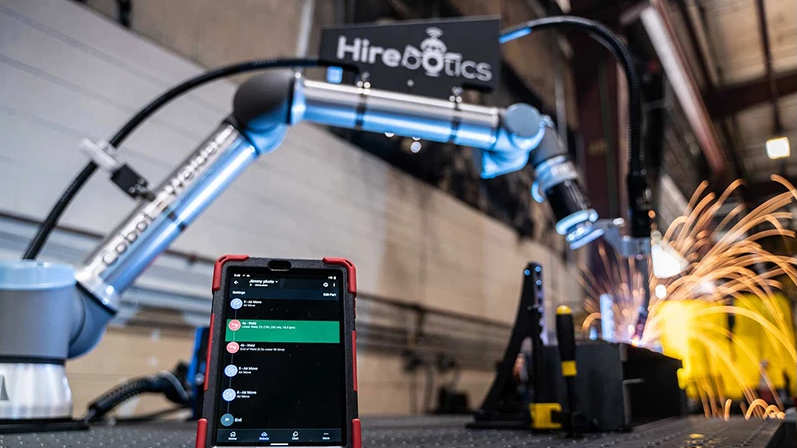
Hirebotics uses the Huncilman Sheet Metal Fabrication case study to make a straightforward argument: cobot welding is a retention tool as much as a productivity tool. When one welder was running three separate operations and absorbing the full physical burden of a product line by himself, the shop did not hire more people. They restructured the workflow around a cobot and changed the daily reality of the hardest job on the floor.
The RBTXpert Take
The Turnover Problem Hiding in Plain Sight
Welding is physically hard in a way that compounds over time. Repetitive overhead positions, heavy part manipulation, heat, fume exposure, and the mental load of maintaining weld quality across a full shift all add up. Most experienced welders do not leave because the pay is bad. They leave because the work eventually becomes unsustainable and nobody did anything about it before they hit that wall.
The shops that feel this most acutely are the ones running a small team where one person has become the load-bearing wall of a production process. When that person leaves, they take the institutional knowledge of every joint configuration, every fit-up quirk, and every customer’s quality expectations with them. Replacing that takes 12 to 18 months minimum, and that assumes you can find someone at all in the current skilled trades market.
The harder truth is that most shops know exactly who that person is. They just have not done anything about the structural vulnerability yet.
What the Guide Gets Right and Where to Read Critically
The Huncilman framing is honest and the retention angle is underreported in automation content. Most vendors lead with throughput numbers. Hirebotics leads with a person who was burning out and a shop that caught it before he walked. That framing will land differently for a shop owner who has already lost a key welder than it will for one who has not yet.
The productivity numbers, two to three additional units per hour and reduced inspection time, are real outcomes. Read them as supporting evidence rather than the primary argument. The primary argument is risk management. A cobot does not call in sick, does not have a bad week after a personal situation, and does not take a competing offer from the shop down the road. That consistency has value that does not show up cleanly in an ROI calculator but every production manager understands intuitively.
Where the guide is thin is on the transition itself. Restructuring three operations into one cell is not a weekend project. Fixture design, program development, and workflow sequencing all require planning time before the cobot arrives. Shops that treat installation day as day one of the project rather than week six or eight of it consistently hit more friction than necessary.
Final Notes
The workforce angle in this guide deserves more weight than most automation conversations give it. Cobot welding changes the physical profile of the job. The welder running the cell is programming, supervising, and handling fit-up rather than burning beads for eight hours straight. That shift in daily activity is meaningful for someone who has 20 years left in their career and a body that is already registering the mileage.
One thing to consider before deployment: involve the welder who will run the cell in the setup process from the beginning. Shops that do this consistently report faster adoption, better program quality, and a stronger sense of ownership over the cell’s performance. The person who knows the parts best should help design the workflow around them. Treating automation as something that happens to the welder rather than with them is the fastest way to create resistance that slows down the return on the investment.
Read the full Hirebotics blog post here.
Find the Hirebotics Cobot Welder on RBTX.com.