
Epoxy Dispensing: Structural Bonding and Potting
1. What This Covers and Why It Matters
Epoxy is the material engineers reach for when the bond or encapsulation must survive what nothing else tolerates. Thermal cycling from -55°C to +150°C, structural loads that exceed substrate strength, vibration environments that fatigue mechanical fasteners, and fluid exposure that degrades most other chemistries over time all point to epoxy. Aerospace structural panels, EV battery modules, automotive powertrain electronics, and defense electronics housings all depend on it.
However, epoxy is also the most unforgiving material in common automated dispensing production use. Mix ratio errors that produce slightly off-spec silicone still cure. Off-ratio epoxy may not cure at all, or may cure with drastically reduced properties that pass visual inspection and fail in the field under load. Exothermic heat generated during cure can distort part geometry in deep-section potting. These failure modes require process discipline that simpler adhesive systems do not demand. This article covers where that discipline concentrates and what breaks when it is absent.
Typical Equipment in This System
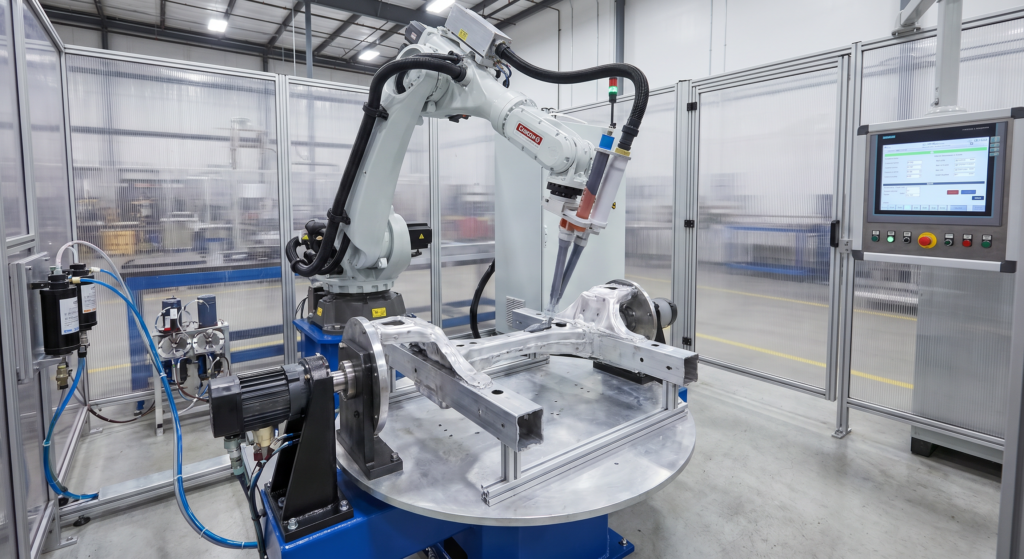
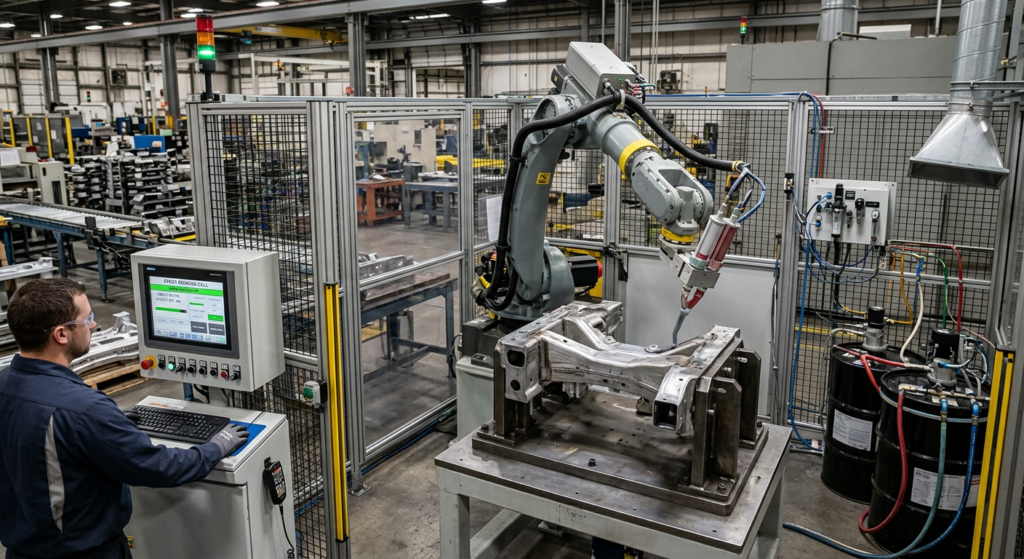
| Equipment | Role or Typical Capability |
|---|---|
| Meter-mix dispensing system | Meters Part A and Part B accurately at the programmed ratio; Graco PR70, Nordson Sievert, and ViscoTec 2K systems are common production examples |
| Static mixer | Combines components through tortuous path elements; disposable; element count and diameter selected for viscosity and required mix quality |
| Dynamic mixer | Motorized impeller actively combines fast-reacting or high-viscosity materials where static mixing alone is insufficient |
| Ratio monitoring system | Verifies actual dispensed ratio continuously; pressure transducers or flow meters on each component line trigger alarms on deviation beyond tolerance |
| Temperature control system | Maintains Part A and Part B at consistent temperature; critical for high-viscosity epoxies where temperature affects both viscosity and pot life |
| Inline weight verification | Scale under the part or shot weighing verifies actual dispensed volume; catches pump wear and partial blockage before defective parts accumulate |
2. How It Works
Mix Ratio: The Variable That Determines Whether the Cure Is Valid
Epoxy cures through a chemical reaction between the resin (Part A) and the hardener (Part B), placing it firmly in the two-part adhesive system category with all its operational tradeoffs.. The ratio between them is not a preference. It is a stoichiometric requirement. Dispensing 10% off-ratio on a structural epoxy can reduce lap shear strength by 30% to 50%. Dispensing 20% or more off-ratio on some formulations produces a part that never fully cures regardless of cure time or temperature. Furthermore, downstream testing cannot reliably catch off-ratio epoxy because the part may pass visual and dimensional inspection while failing structurally under load.
This sensitivity makes ratio monitoring non-negotiable on structural and potting applications. Production cells on automotive structural bonding lines track ratio in real time through pressure transducers on each component line. A deviation beyond the tolerance window, typically ±2% to ±5% depending on the material, stops the cell before an off-ratio part advances to the cure oven. Relying on operator response to an alarm rather than automatic shutdown accepts that some off-ratio parts will reach cure before the operator acts. Beyond process discipline, the resin and amine hardener components carry sensitization risks that demand task-specific chemical safety protocols for any epoxy dispensing cell.
Exothermic Cure: The Problem That Surprises Deep-Section Potting Operations
The epoxy cure reaction generates heat. In thin bondlines, that heat dissipates quickly and causes no problem. In deep-section potting, the exotherm accumulates because the surrounding cured material acts as insulation. As a result, internal temperatures in deep epoxy pots can reach 150°C to 200°C depending on chemistry, fill volume, and ambient conditions. At those temperatures, the cured epoxy shrinks on cooling. Cracking, delamination from housing walls, and housing distortion on plastic or thin-wall aluminum enclosures all follow.
Controlling exotherm in production requires one of three approaches. First, select a low-exotherm epoxy formulation, which typically trades cure speed for thermal management. Elantas, Huntsman, and Dow all offer potting epoxies formulated for low peak exotherm in large volumes. Second, dispense in layers and allow partial cure between fills to limit the reactive mass in any single pour. Third, chill the mixed material or the housing before dispensing to slow the initial reaction rate. AMD Machines and Nordson both document chilled dispensing configurations for high-volume potting lines where exotherm management is a designed-in requirement rather than an afterthought.
Pot Life and Purge Cycle Management
Pot life is the time from mixing to the point where mixed material becomes too viscous to dispense reliably. It varies from under 2 minutes for fast-curing structural acrylics to over 60 minutes for large-volume potting compounds. In either case, the cell must manage pot life through programmed purge cycles. On a structural bonding cell running a 5-minute pot life epoxy, the purge cycle fires at 3 to 4 minute intervals during idle periods. Each purge flushes the mixer with a short shot into a waste receptacle, replacing any material that has begun to advance toward gelation.
At shift-end shutdown, 2K epoxy cells require a full flush of the mixer and a portion of the supply lines. Failing to flush at shutdown means the mixer arrives at the next shift startup partially cured. Replacing the mixer takes minutes. Clearing cured epoxy from supply lines takes significantly longer. On high-volume lines, shutdown and startup procedures for 2K epoxy cells carry as much operational importance as the dispensing program itself.
Where Epoxy Dispensing Is Used: Structural Bonding
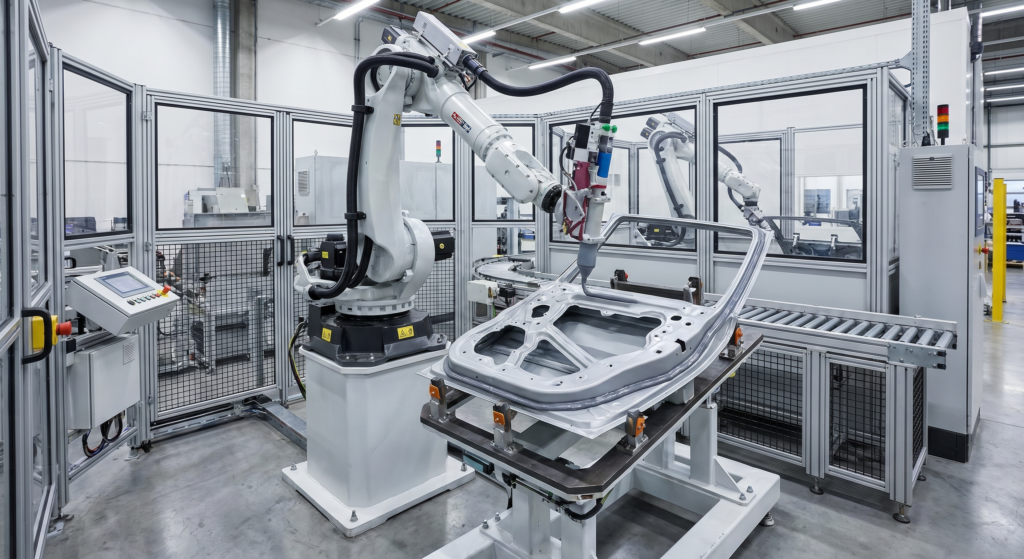
Automotive OEMs bond roof panels, door assemblies, and structural reinforcements with two-part epoxies that match or exceed substrate tensile strength. Dow’s Betamate series, Henkel’s Teroson and Loctite Hysol series, and 3M’s Scotch-Weld series achieve lap shear strengths of 20 to 35 MPa on steel and aluminum. Beyond strength, epoxy distributes load across the full bond area rather than concentrating it at fastener points. This improves fatigue resistance in cyclic load applications and reduces stress concentrations at joint edges.
In EV battery manufacturing, two-part epoxy bonds module housings to thermal management plates, seals cell-to-cell gaps, and encapsulates high-voltage connectors. The thermal cycling range of a battery pack, from cold soak at -40°C to charge heat above +60°C, demands an adhesive that maintains bond integrity across that range without fatigue failure. Epoxy is the dominant structural choice because no other adhesive chemistry combines the strength, temperature resistance, and fluid resistance that battery pack design requires.
Where Epoxy Dispensing Is Used: Electronics Potting
Potting with epoxy encapsulates PCB assemblies, power modules, and sensor electronics against moisture ingress, vibration, thermal shock, and chemical exposure. Military and aerospace electronics specify epoxy potting extensively because encapsulated assemblies must survive environments that conformal coating cannot address: full immersion, salt fog, vibration levels that would fracture unprotected solder joints, and thermal cycling across hundreds of cycles.
Nordson Sievert and Graco meter-mix systems handle the majority of industrial epoxy potting production. The robot dispenses mixed epoxy into the housing cavity, the material self-levels, and cure proceeds volumetrically through the full section simultaneously. Unlike moisture-cure silicone used in form-in-place gasketing, which cures from outside in and struggles in deep enclosed sections, epoxy cures throughout the full depth through the catalyst reaction regardless of geometry. Elantas and Huntsman supply widely used potting formulations for electronics applications, ranging from flexible low-modulus systems for high differential thermal expansion to rigid high-Tg systems for elevated temperature environments.
3. Common Failure Modes and Constraints
| Failure | Root Cause | Signal or Symptom |
|---|---|---|
| Incomplete cure or soft spots | Mix ratio deviation beyond tolerance; off-ratio material in first shot after idle period | Tacky surface at cure check; reduced Shore D hardness; bond fails under structural load |
| Housing distortion after potting cure | Exothermic heat accumulation in deep section; high-exotherm epoxy in large fill volume | Housing warped or cracked after cure; delamination at housing wall visible on cross-section |
| Mixer blockage at startup | Epoxy cured inside static mixer during idle period without purge; inadequate shutdown flush | No flow at cycle start; pressure builds without material exiting nozzle |
| Bondline voids in structural joint | Air entrained during mixing; material not degassed before fill | Voids visible on cross-section at destructive test; lap shear below specification |
| Adhesion failure at substrate | Surface contamination; incorrect primer; epoxy incompatible with composite release agent | Bond peels at interface rather than failing cohesively through epoxy body |
Bondline geometry and consistency in structural epoxy applications depend on the same bead control fundamentals that govern every dispensing cell. Off-ratio cure generates the most expensive downstream consequences. It is invisible at the dispensing station and may not appear until field loading. Ratio monitoring with automatic cell shutdown on deviation is the only production-reliable method for preventing off-ratio parts from reaching the cure oven. In addition, mixer blockage from missed purge cycles is the most common maintenance failure on 2K epoxy cells. Both problems are entirely preventable through cell design decisions made before production begins.
4. Good Fit vs. Bad Fit
Good fit when:
Epoxy dispensing delivers clear return for structural load-bearing bonds, deep-section potting where moisture cure cannot penetrate, and applications requiring long service life across wide thermal and chemical exposure ranges. Electronics potting for defense and industrial applications, structural panel bonding in automotive and aerospace, EV battery module assembly, and power electronics encapsulation all fit this profile. Moreover, epoxy automation replaces manual potting processes where operator volume variation produces high scrap rates at downstream electrical or structural test.
High risk when:
The investment carries elevated risk when pot life management is not designed into the cell from the start. Operations that discover they need purge cycles after commissioning are already managing blockage incidents reactively. Similarly, exotherm in deep-section potting requires proactive thermal management. Adding chilled dispensing lines or layer-pour sequences after geometry and cycle time are already optimized is significantly more difficult than designing for exotherm from the beginning.
Usually the wrong tool when:
Epoxy is the wrong choice for joints requiring future disassembly. Cured structural epoxy cannot be removed without damaging the substrate. Applications requiring periodic access or component replacement should instead use silicone, removable threadlockers, or other reversible chemistries. Beyond rework, epoxy is unnecessary for low-load sealing applications where RTV silicone or a UV-cure adhesive meets the performance specification at lower complexity and cost.
5. Key Questions Before Committing
- What is the required lap shear strength and minimum service temperature range, and does the epoxy data sheet confirm these properties at the production mix ratio and the actual cure schedule?
- For potting applications, what is the maximum fill depth per pour, and has the exothermic temperature rise been calculated or measured at that depth and volume to confirm it stays within the housing material’s thermal limit?
- What is the material’s pot life at the facility’s maximum ambient temperature, and has the purge cycle interval been set at no more than 70% of that pot life to prevent mixer gelation during normal production pauses?
- What ratio monitoring system is specified, and does it trigger automatic cell shutdown on deviation rather than relying on operator response to an alarm?
- What substrate preparation runs upstream of dispensing, and has adhesion been validated on production-representative parts with real surface conditions rather than laboratory-prepared coupons?
6. How RBTX Learn Recommends Using This Information
RBTX Learn recommends treating mix ratio monitoring as mandatory infrastructure on any structural or potting epoxy cell. The cost of a pressure transducer ratio monitoring system is trivial relative to a single off-ratio structural bond discovered in field service. Design it in from the start rather than adding it after the first quality escape.
On exotherm, confirm the peak temperature rise before the first production pour. Ask the epoxy supplier for exotherm data at the planned fill volume and geometry. If the peak temperature exceeds the housing material’s limit, select a low-exotherm formulation or reduce pour depth before the cell design is finalized. Addressing this at material selection costs an engineering hour. Addressing it after the cell is running costs significantly more.