
Automation Applications in Upstream Packaging Operations
1. What This Resource Covers & Why It Matters
Packaging machines are only as fast as the product flow feeding them — which is why upstream stabilization is one of the most impactful automation opportunities on any packaging line. Form-fill-seal systems, cartoners, and case packers all depend on products arriving evenly spaced, correctly oriented, and synchronized with machine cycles. When upstream product flow is inconsistent, downstream packaging equipment slows, stops, or produces defects regardless of how well it is maintained or programmed.
The upstream packaging stage covers everything that happens between manufacturing or assembly and the first packaging machine. Products leaving molding machines, machining centers, or assembly lines frequently arrive in random orientations, irregular intervals, or bulk configurations that packaging equipment cannot handle directly. Upstream automation converts that uncontrolled output into structured, consistent input.
This article covers the real automation systems solving upstream packaging problems today: robotic pick-and-place, singulation conveyors, vision-guided orientation, and accumulation buffering. The downstream stage, covering case packing, sealing, and palletizing, is covered separately.
2. What’s Actually Happening: Real Deployments
Food and Beverage: Handling Irregular Product at Speed
Food manufacturers face upstream automation challenges that other industries rarely encounter. Products arrive from fryers, ovens, or fillers in random orientations, at variable intervals, and sometimes in fragile or deformable states. Syntegon’s robotic pick-and-place platforms serve bakery manufacturers specifically because delta robots operating at up to 140 picks per minute can handle delicate baked goods arriving in random positions on a flat belt. HUG, a Swiss bakery manufacturer, deployed Syntegon’s RPP robotic packaging platform to handle precisely this problem. Products arrive from production in variable positions. Vision-guided delta robots identify each item’s location and orientation, pick it cleanly, and place it into a carton infeed in the correct position for downstream cartoning equipment.
Beyond pick-and-place, food lines use accumulation buffers between production equipment and packaging infeed to absorb rate mismatches. When a filler runs slightly faster than a cartoner for a period, the buffer absorbs the surplus without stopping either machine. In practice, eliminating those stops across a two-shift operation produces measurable OEE improvement without adding a single machine.
Pharmaceutical and Medical Device: Orientation and Traceability Before Packaging
Pharmaceutical upstream automation centers on two requirements that food lines rarely face at the same intensity: orientation precision and unit-level traceability. Tablets, vials, syringes, and ampoules must arrive at filling or cartoning equipment in a defined orientation. A vial loaded sideways into a cartoner produces a jam and a line stop. Beyond that, regulated manufacturers must verify product presence and identity before packaging seals the unit.
Vibratory bowl feeders orient small pharmaceutical components reliably at volumes exceeding several hundred parts per minute. For more complex geometries, vision-guided robotic handling provides orientation flexibility without mechanical change parts. OMRON’s i4 SCARA robots appear frequently in pharmaceutical upstream applications precisely because their compact footprint and high repeatability suit the tight-tolerance product handling that regulated environments require. Vision systems verify product identity and orientation before the robot executes a pick, generating the audit record that FDA process validation documentation demands.
Electronics and Consumer Goods: Multi-SKU Flexibility
Consumer electronics assembly lines produce multiple product variants on the same line, often switching several times per shift. Upstream automation in these environments must handle changeovers faster than mechanical orientation equipment allows. Vision-guided robotic systems address this by reading product geometry rather than relying on fixed mechanical guides that require adjustment for each variant.
Techman Robot’s vision-integrated cobots appear in electronics upstream handling applications where the product mix is too varied for dedicated mechanical feeders. The robot’s integrated camera identifies which product variant is present and selects the appropriate pick strategy without operator intervention. Beyond that, this approach eliminates the tooling inventory that mechanical orientation systems require for each SKU, which reduces changeover cost and changeover time simultaneously.
3. How the Technology Works
Singulation and Spacing Control
Bulk product flow from manufacturing equipment arrives as a disorganized mass on a conveyor. Singulation systems separate that mass into a single-file stream with controlled spacing. Diverging conveyors spread product laterally while running at different speeds, separating items that were touching. Timing belts or indexing conveyors then establish defined gaps between products before they reach a robot pick zone or packaging machine infeed.
Spacing consistency is the variable that determines whether downstream systems run cleanly. A packaging machine rated for 200 products per minute requires product arriving at a steady 200-per-minute rate with consistent gaps. Products arriving in bursts, even at the same average rate, cause the machine to wait during gaps and jam during surges. Singulation systems convert average-rate flow into consistent-interval flow, and that conversion is what allows high-speed packaging equipment to reach nameplate throughput.
Vision-Guided Orientation
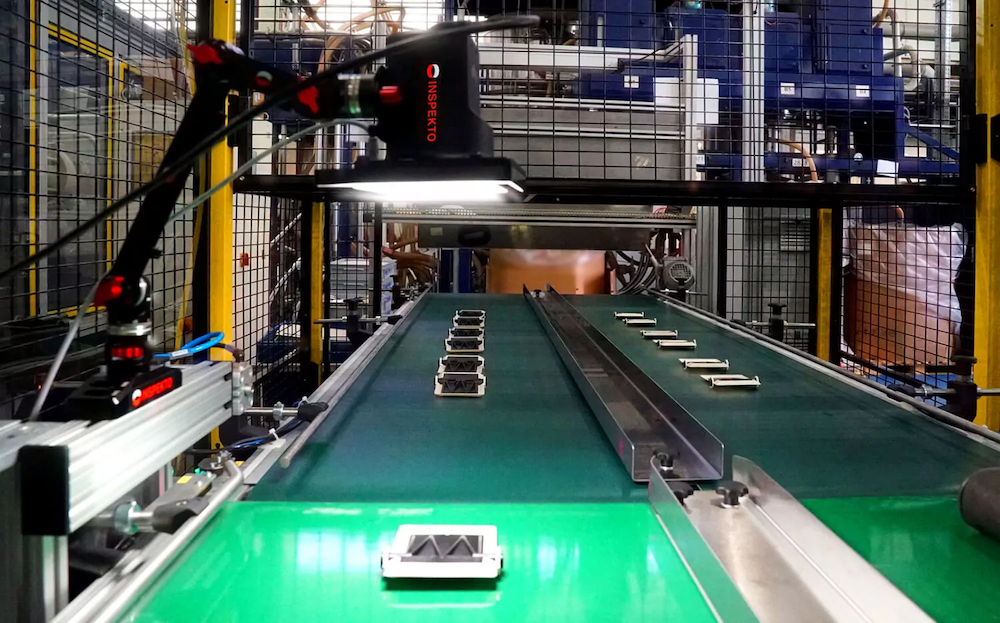
Vision systems used upstream of packaging equipment do not inspect for defects. They locate and measure. A camera positioned above the infeed conveyor captures each product’s position and angular orientation. Software calculates the offset between the product’s actual position and the position the downstream system requires. The robot controller receives those coordinates and adjusts its pick path accordingly, placing the product into the packaging infeed in the correct orientation regardless of how it arrived.
Lighting design determines whether vision-guided systems work reliably or generate false reads that stop the line. Consistent, controlled illumination eliminates the shadows and reflections that cause detection failures under ambient factory lighting. Backlighting, structured light, and dome illumination each suit different product geometries. Specify the lighting alongside the camera, not as an afterthought during commissioning.
Robotic Pick-and-Place in Upstream Applications
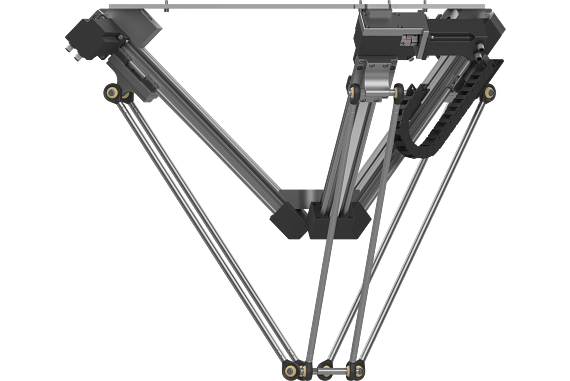
Delta robots dominate high-speed upstream pick-and-place applications because their parallel kinematic structure produces very fast cycle times at low payloads. OMRON’s iX3 and iX4 delta platforms, Syntegon’s RPP systems, and similar architectures operate at cycle rates suited for the fastest packaging lines in food, pharma, and consumer goods. Six-axis robots appear when product geometry requires complex approach angles or heavier payloads that delta systems cannot handle.
In upstream applications, robots transfer products from a bulk or singulated infeed into a structured format for the downstream packaging machine. That might mean placing products into a tray, loading them into a cartoner infeed lane, or orienting them onto a conveyor in a defined pattern. The robot’s job is not speed alone. It is the conversion from unstructured flow to structured presentation, and that conversion defines whether the packaging machine downstream can run at its rated throughput.
Accumulation Buffering
Accumulation conveyors store products between upstream production equipment and downstream packaging machines when the two operate at slightly different rates. Without buffering, a momentary slowdown in production causes the packaging machine to starve. A momentary surge causes a jam. Accumulation systems absorb both conditions by providing a reservoir that feeds the packaging machine at a constant rate even when the upstream rate varies.
Zero-pressure accumulation conveyors prevent product-to-product contact during accumulation, which matters for fragile food items or cosmetically sensitive consumer goods. Mass flow accumulators store bulk product in a controlled pool rather than a single-file lane, providing higher storage capacity for operations where production-to-packaging rate mismatches are significant.
4. The Business Case
The return on upstream packaging automation appears in OEE rather than in direct labor reduction, and that framing matters for the business case. A packaging machine running at 65% OEE due to upstream stoppages and infeed bottlenecks delivers the same output as a machine running at 85% OEE when upstream flow is stabilized, without any change to the packaging machine itself. That 20-point OEE improvement on a machine valued at $500,000 to $2 million represents significant recovered throughput at no additional equipment cost.
Labor impact is secondary but real. Manual product orientation and singulation at the infeed of a packaging machine is ergonomically demanding and pace-constrained. A two-person manual infeed team at $65,000 fully burdened each year costs $130,000 annually. A robotic pick-and-place system addressing the same function runs $80,000 to $200,000 installed, depending on complexity, with payback driven by both labor savings and the OEE recovery on downstream equipment.
Changeover cost is the third component of the return. Operations running multiple SKUs per shift pay a changeover penalty on every product switch. Vision-guided robotic systems that switch by program selection rather than mechanical adjustment reduce that penalty from 30 to 90 minutes to under 10 minutes per changeover. Across 15 product switches per week, that recovery compounds significantly over a year.
5. Limitations and Caveats
Vision systems work reliably under controlled lighting and with products that present consistent, machine-readable surfaces. They struggle with reflective surfaces, transparent products, and products whose geometry changes across a production run due to process variation. Specify lighting alongside camera hardware, test under actual production conditions before commissioning, and budget for a lighting revision as part of the project contingency.
Delta robots at high cycle rates require precise mechanical maintenance. Bearing wear in the parallel kinematic structure produces positional drift that degrades pick reliability before generating a fault alarm. Establish a preventive maintenance schedule based on the manufacturer’s cycle count specifications, not on a calendar interval. Operations that maintain delta robots on calendar schedules discover positional drift in production quality before they see it in a maintenance record.
Accumulation buffering does not eliminate rate mismatches. It absorbs them temporarily. An operation where production consistently runs 20% faster than packaging will exhaust any practical accumulation buffer within a shift. Upstream automation stabilizes flow. It does not substitute for capacity planning between production and packaging.
6. When It’s a Good Fit vs. Bad Fit
Good fit when:
Upstream automation delivers the clearest return when a well-maintained, capable packaging machine is running below its rated throughput due to inconsistent product presentation at the infeed. In that scenario, the machine is already paid for and the bottleneck is upstream. Stabilizing that flow recovers throughput without a capital investment in additional packaging equipment. Beyond throughput, multi-SKU operations where product switches happen more than twice per shift benefit significantly from vision-guided robotic handling that switches by program rather than by mechanical adjustment.
High risk when:
The investment carries risk when product geometry or surface condition has not been validated against the proposed automation before equipment is ordered. Flexible pouches, reflective surfaces, and products with dimensional variation from the process create handling failures that surface during commissioning rather than during specification. Require physical product samples to be tested with the proposed tooling and vision system before purchase orders are signed.
Usually the wrong tool when:
Upstream automation is the wrong investment when the actual constraint is downstream, not upstream. Installing a robotic pick-and-place system that delivers products faster to a packaging machine already running at capacity does not improve throughput. It adds complexity. Map the full line and confirm where the bottleneck actually lives before specifying upstream automation. If the packaging machine is the constraint, address the packaging machine first.
7. Key Questions Before Committing
- What is the documented OEE of the downstream packaging machine, and have you traced the stop events causing downtime to confirm that upstream product flow variability is the root cause rather than machine faults or changeover time?
- Has the proposed end-of-arm tooling or singulation system been tested with actual product samples under production conditions, including any surface variation, moisture, or dimensional tolerance range the process produces?
- What is the full SKU count running through this infeed, how often does the product switch per shift, and has changeover time been included in the throughput model?
- Does the lighting specification for any vision system reflect actual factory conditions, including ambient light variation across shifts, and has the vision system been tested under those conditions rather than in a controlled demo environment?
- What is the rate mismatch between upstream production equipment and the downstream packaging machine, and is that mismatch within the capacity of the proposed accumulation buffer across a full shift?
8. How RBTX Learn Recommends Using This Information
RBTX Learn recommends starting any upstream packaging automation evaluation with an OEE audit on the downstream packaging machine rather than with an equipment catalog. Document stop events, their duration, and their root causes across at least five production shifts. If upstream product flow irregularity appears in the stop log, quantify how many minutes per shift it costs and what throughput recovery is worth at the facility’s production value per hour. That number is the return the upstream automation needs to beat.
On technology selection, match the automation type to the specific problem rather than to the broadest solution available. A singulation conveyor and accumulation buffer may recover 15 OEE points on a packaging machine at a fraction of the cost of a full vision-guided robotic system. Start with the minimum intervention that solves the documented problem and scale from there as throughput data confirms the return.