
RBTXpert Debrief: The Real Cost of Outsourcing Your Painting/Finishing Work
Partner Resource: Hirebotics, Cobot Painting vs. Manual Spraying: What to Know
Content Type: Industry Perspective and Buying Guide
Best For: Fabrication shop owners and operations managers currently outsourcing coating work or evaluating whether to bring finishing in-house
Who Should Read This
This debrief is for any shop where coating is either sent out or sprayed by hand, and someone has asked whether a cobot changes the math. Where you start determines what a cobot painter actually costs you.
Industry sectors: Metal fabrication, structural steel, custom manufacturing, job shops, contract manufacturing, agricultural equipment, heavy equipment, and any operation where coating or painting is currently outsourced as a matter of course rather than a deliberate strategic choice.
Job roles and departments: Shop owners and operations managers weighing the capital request, estimators and project managers who pad quoted lead times around an outside coater, quality leads who own finish complaints, and EHS or facilities staff who will own the permits.
Company size: Small to mid-size fabrication shops with 10 to 150 people where painting is not a core capability but finish quality directly affects customer perception and repeat business. This is particularly relevant for shops where the coating vendor relationship is the weakest link in an otherwise tight production process.
Who else this concerns: Project managers quoting lead times, customer service teams managing delivery expectations, and quality leads who field complaints about finish defects after shipment. Every one of them is absorbing the downstream consequences of a process the shop does not control.
Find your starting position first. Every section below refers back to these three cases.
| Starting position | What you already have | What a cobot painter replaces | What you still need to budget |
|---|---|---|---|
| A. You hand-spray in-house today | Booth, exhaust, and (for powder) a cure oven, plus an air permit if one applies | The manual sprayer’s gun work | The cobot system, training, and an updated risk assessment |
| B. You outsource all coating | Nothing coating-specific | The outside coater’s application step | Pretreatment, a compliant booth or spray room, a cure oven for powder, racking, permits, and the cobot system |
| C. You outsource specialty coatings | Varies | Nothing, for that work | Nothing new; keep the specialty coater |
The Hirebotics guide is written to readers in position B but describes a deployment that fits position A. Keep that gap in mind as you read it.
What This Covers
Hirebotics argues that outsourced coating costs far more than the coater’s invoice, that traditional paint lines priced small shops out of doing it themselves, and that a portable, no-code cobot painter built on the FANUC CRX-10iA/L Paint closes that gap. The guide walks through a worked cost example and names the jobs a cobot should not take on.
The guide is a strong case for why outsourcing hurts. This debrief adds what a buyer needs to act on it: where the cobot fits in the coating process, the payback math with a published system price, the prep and inspection standards that decide finish quality, and the compliance items to clear before delivery.
The RBTXpert Take
The Cobot Painter Replaces the Sprayer, Not the Paint Line
The guide compares a cobot painter with a full paint line, but the two do different jobs. Hirebotics itself defines a traditional powder system as a washer, booth, oven, and conveyor. A cobot painter is none of those four. It takes over the gun work that a person does today.
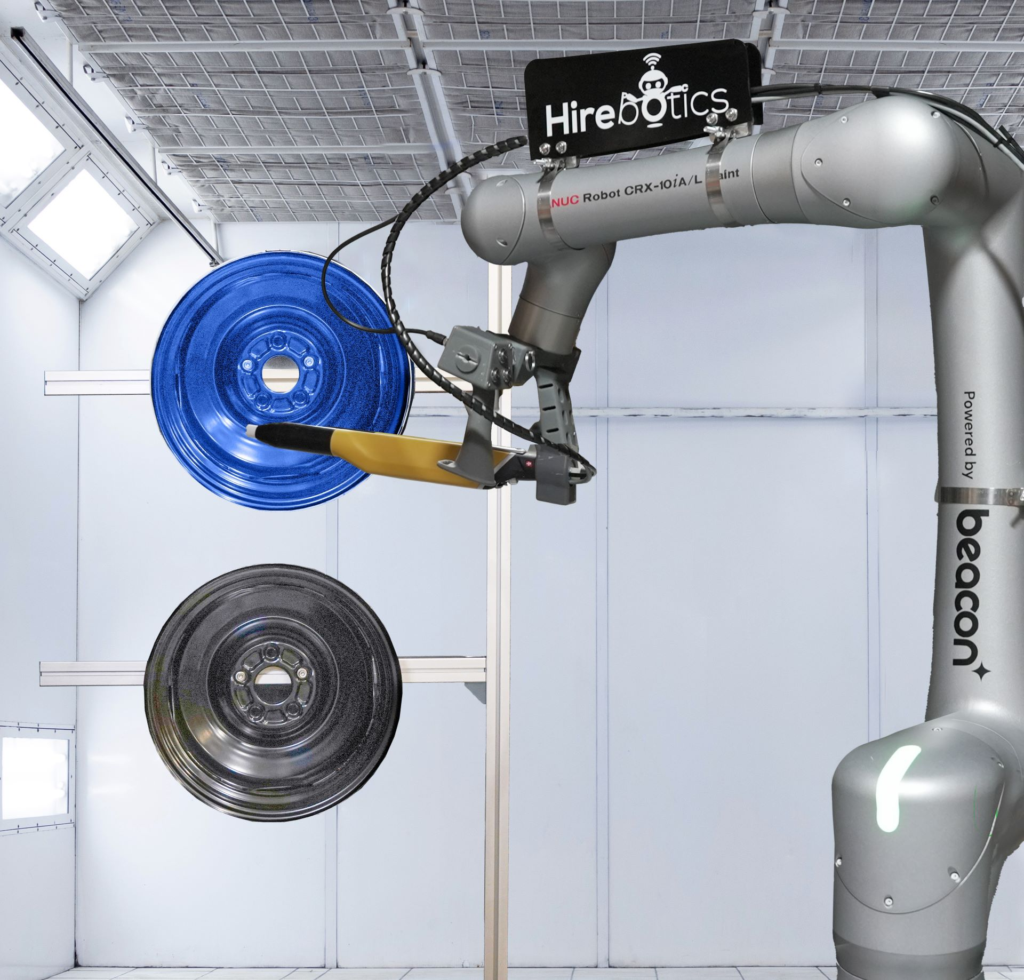
Hirebotics publishes what the Cobot Painter package includes at its $140,000 starting price: the FANUC CRX-10iA/L Paint arm, a Nordson Encore powder system, Graco and Binks liquid equipment, an operator panel with e-stop, a portable stand with floor mounts, and Beacon software with a spray-gun-shaped teaching handle. Everything else in the finishing process stays with you.
| Finishing step | Who does it when you outsource | Does the cobot painter do it? |
|---|---|---|
| Cleaning and pretreatment (degrease, blast, or chemical wash) | The coater | No |
| Masking, hanging, and racking | The coater | No |
| Spray application | The coater’s sprayer | Yes |
| Ventilation and overspray capture | The coater’s booth | No, it needs a compliant booth or spray room |
| Cure (powder) or dry (liquid) | The coater’s oven or flash area | No |
| Inspection for film thickness and adhesion | The coater | No |
| Cooling, offloading, and packing | The coater | No |
For a position A shop that already sprays by hand, the guide’s pitch fits as written. The real comparison is the cobot against your sprayer: the same standoff distance, gun angle, and travel speed on every pass, and a painter freed up for prep, masking, and inspection. FANUC rates the arm’s repeatability at ±0.04 mm under ISO 9283, so run-to-run path consistency is not the limiting factor. Prep, powder or paint settings, and cure are.
For a position B shop that outsources everything, the guide’s promise of no booth construction assumes a spray environment you do not have. Hirebotics’ own product page describes the cobot rolling into an existing manual booth. Before you run the payback math below, get quotes for the pretreatment, booth, cure oven, and racking you would need. Those items, not the robot, decide whether position B pencils out.
Run the Payback Match with the Price in it
The guide’s worked example ends with payback “within the first year or two” but never states the system price. At Hirebotics’ own published starting price of $140,000, the example shop cannot pay back in year one even if coating in-house cost nothing.
The math is simple enough to run on your own numbers:
Here is what that formula does to the guide’s two examples at the $140,000 starting price.
| Hirebotics example | Outsourcing cost avoided per year | Payback if in-house cost were $0 | Most you can spend in-house per year for a 2-year payback |
|---|---|---|---|
| 5 batches a week at $250 | $65,000 | 2.2 years | Not reachable, even at $0 |
| 20 batches a month at $300, plus $12,000 freight and packaging | $84,000 | 1.7 years (20 months) | $14,000, or about $58 per batch |
That $14,000 does not stretch far. The BLS median wage for coating, painting, and spraying machine operators is $23.20 an hour, and wages make up 70.0% of private-industry employer compensation costs. That puts a loaded operator hour at about $33. So $14,000 covers roughly 420 operator hours a year, or about eight hours a week, before any powder, paint, fuel, electricity, filters, or support plan.
The guide’s two-year payback is realistic for a position A shop whose booth and oven are paid for and whose staff can absorb the work. It gets harder quickly for a shop that has to hire workers or buy the equipment in the table above.
Build your own worksheet from these inputs:
| Input | Where to find it |
|---|---|
| Outsourcing cost avoided | Twelve months of coater invoices, freight, packaging, and rush charges. Count only work you would actually bring in-house. |
| Up-front cost | The cobot system quote, plus any booth, oven, pretreatment, racking, electrical, or permitting work you lack |
| Labor | Hours per batch for prep, masking, loading, spraying, curing, unloading, and inspection, times your loaded rate. If existing staff absorb it, say so in the model. |
| Materials | Powder or paint per batch, from your coating supplier’s data sheet and coverage rate |
| Utilities and consumables | Oven fuel, booth exhaust power, compressed air, filters, hooks, and masking |
| Support | Optional: Beacon Care is $5,000 per system per year; Beacon Pro is $80 per cobot per month |
The guide is right that rush fees, transit damage, and padded lead times cost real money. Put them in the model only as figures you can document: rush charges on invoices, rejected batches in your quality log, and jobs lost on lead time in your quote records. The guide also cites an unnamed source for cycle times dropping by up to 30%. Without the source, treat that as a hypothesis to test against your own records, not a model input.
Finish Quality is Decided Before and After Spraying
A cobot makes the spray step repeatable. It does not clean the part beforehand or cure it afterward, so those steps need their own controls.
EPA’s painter-training rule for spray shops names the technique variables that set film build: gun distance and angle, banding and overlap, and lead and lag at each stroke. A taught cobot path locks those variables in. Measure dry film thickness on hand-sprayed parts before the cobot arrives and again after, and you will have evidence instead of a sales claim.
Pretreatment is a chemistry decision, not an equipment one. Coating industry guidance is to start with a pretreatment chemical supplier, because your corrosion requirements usually set the number of washer stages and the type of conversion coating.
Clear Compliance Before the Cobot Arrives
The cobot’s explosion-proof certification covers the arm. The space around it is the shop’s responsibility, and the rules differ for liquid paint, powder, and gel coat. FANUC Europe lists the arm for ATEX Zone 1 (gas) and Zone 21 (dust), and Hirebotics lists IECEx and ATEX certification plus approvals for the U.S., Canada, and five other markets.
| Item | What the rule says | What to confirm before you buy |
|---|---|---|
| Where spraying can happen | OSHA 29 CFR 1910.107 allows spraying only in predetermined spraying areas, and 1910.94(c)(2) calls for spray booths or spray rooms to enclose spray finishing | That a booth or spray room exists, is ventilated, and is large enough for the cobot, its stand, and your largest part |
| Booth airflow | For spraying other than electrostatic, OSHA 1910.107 sets a minimum average face velocity of 100 linear feet per minute | A measured airflow reading, not a nameplate rating |
| Electrical zones around the cobot | Equipment in a spraying area must be rated for Class I, Division 1; equipment within 20 feet and not separated by partitions must meet Class I, Division 2 | Where the controller cabinet, operator panel, and any tablet or phone running Beacon will sit relative to those zones |
| Fire code | OSHA’s rule was adopted from the 1969 edition of NFPA 33; local fire officials typically enforce a newer edition | Sign-off from your local fire authority before installation |
| Gel coat and other plural-component materials | OSHA 1910.107(m) requires approved sprinklered spray booths for organic peroxides and dual-component coatings | Sprinkler coverage, if you plan to use the cobot for gel coat or fiberglass work |
| Liquid coatings containing target HAP metals | EPA’s 6H rule (40 CFR 63 Subpart HHHHHH) requires 98% overspray filters, HVLP or equivalent guns, enclosed gun cleaning, and painter training renewed every five years | Whether your coating safety data sheets list chromium, lead, manganese, nickel, or cadmium compounds at regulated levels |
| Air permits | State and local air agencies set their own permit and registration thresholds | Whether a new or expanded coating operation needs a permit at your site |
Two details in the 6H rule are worth knowing. Powder coating is excluded from its definition of spray-applied coating, which can simplify compliance for powder-only shops. The rule also defines spray application in terms of hand-held devices. How that applies to a cobot that an operator hand-guides during teaching is a question for your state air agency, so keep painter training current until you have its answer in writing.
The cobot also shares space with people by design. It reduces the time a person spends at the gun, but anyone in the booth while spraying runs still needs the same respiratory protection and PPE program a manual sprayer would.
The Bottom Line
Hirebotics makes a strong case for why outsourced coating costs more than the invoice, and it is candid that specialty coatings should stay with specialists. The case holds best for shops that already have somewhere to spray and cure. Before you act on it:
- Name your starting position (A, B, or C) and list the finishing steps the cobot will not cover.
- Run the payback formula with the system price and your own operating costs, not the guide’s example.
- Write film thickness, adhesion, and cure criteria, and use them with your current coater now.
- Clear the booth, electrical, fire, and air items with the people who will sign off on them
A shop that does all four will know whether a cobot painter pays back, and how fast, before the first part is sprayed.
Read the full Hirebotics cobot painting guide here.
Find the Hirebotics Cobot Painter on RBTX.com.