
Automation Applications in Downstream Packaging Operations
1. What This Resource Covers & Why It Matters
Downstream packaging is one of the highest-value automation opportunities in modern packaging lines — where finished goods stop being products and start becoming shipments. Once a product is in its primary package, a coordinated sequence of machines groups it, seals it, labels it, verifies it, stacks it, and secures it for transport. Each step depends on the one before it. When any station in that sequence slows or stops, the entire line backs up.
This is also where the most manual labor in a packaging operation concentrates. Case packing, palletizing, and stretch wrapping are repetitive, physically demanding tasks that are difficult to staff reliably and nearly impossible to sustain at consistent quality across a full shift. Ergonomic injury rates at these stations are among the highest in manufacturing. Turnover is high. And as production speeds increase, the gap between what manual teams can sustain and what the line demands widens.
This article covers the automation systems that address these problems: what they are, how they connect, where they fail, and how to evaluate whether the investment fits a specific operation. The upstream stage covering singulation, orientation, and infeed preparation is addressed in a separate article.
2. What’s Actually Happening: Real Deployments
Food and Beverage: End-of-Line Automation at Scale
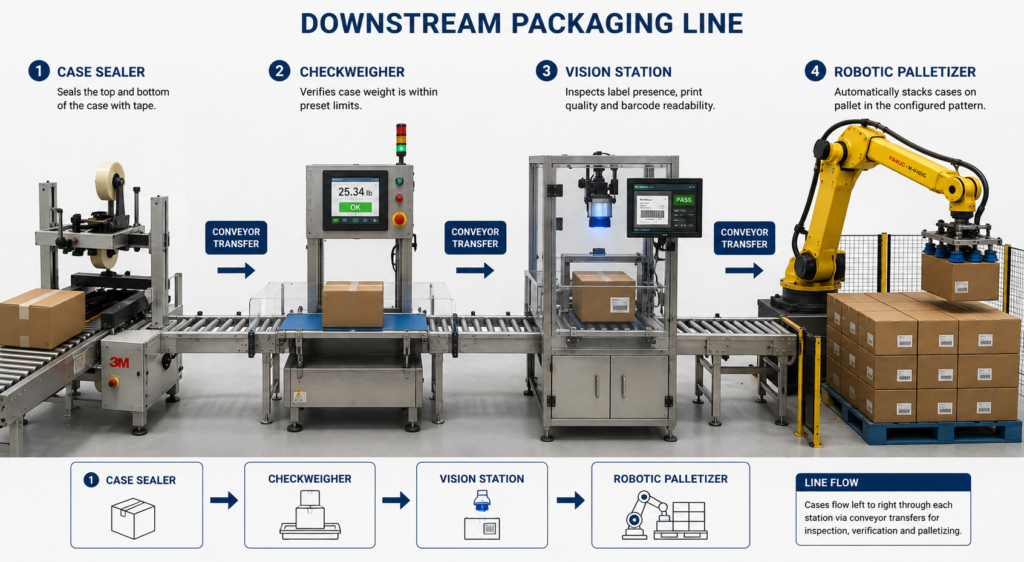
Food and beverage producers were among the earliest adopters of downstream automation, driven by high throughput requirements and labor-intensive end-of-line operations. Menasha, a packaging company, eliminated manual palletizing across multiple lines by deploying FANUC case palletizing robots, directly addressing a labor shortage that was creating daily production variability. Beyond palletizing, major beverage producers run fully integrated downstream sequences where case packers, sealers, checkweighers, and robotic palletizers operate as a coordinated system with no manual handling between primary packaging and the stretch wrapper.
The food industry’s downstream automation challenge is not just speed. It is sanitation. Equipment must be cleanable to food-grade standards, which influences conveyor design, enclosure requirements, and the materials used in end-of-arm tooling. Stainless steel conveyors, IP65-rated components, and open-frame robot designs that allow washdown are standard specifications in food downstream environments.
Pharmaceutical and Medical Device: Traceability as a Driver
In pharmaceutical downstream packaging, regulatory traceability requirements drive automation investment as much as throughput does. Every case leaving a pharma facility must carry serialized labeling that links the case to a specific production batch, and that linkage must be verified before the case is sealed. Vision systems that confirm label placement, barcode readability, and print quality before the case sealer closes the carton are not optional in regulated environments. They are part of the compliance architecture.
Sharp, a contract packaging organization serving pharmaceutical manufacturers, deployed Tulip-guided digital workflows and downstream automation to digitize clinical trial packaging. The result was a 30% improvement in packaging speed alongside improved quality documentation and simplified FDA compliance. In pharmaceutical downstream operations, the data trail generated by labeling, vision, and checkweigher systems is as important as the physical packaging output.
Consumer Goods and E-Commerce: High-Mix, Fast Changeover
Consumer goods manufacturers running high SKU counts face a different downstream challenge. The machines must handle multiple box sizes, pallet patterns, and label formats across a shift without extended changeover. Robotic palletizers programmed with multiple pallet patterns switch between configurations at the HMI in minutes. Automated labeling systems pull the correct label format from a connected MES or ERP based on the active work order. Vision systems verify that the right label went on the right case before it moves to the palletizer.
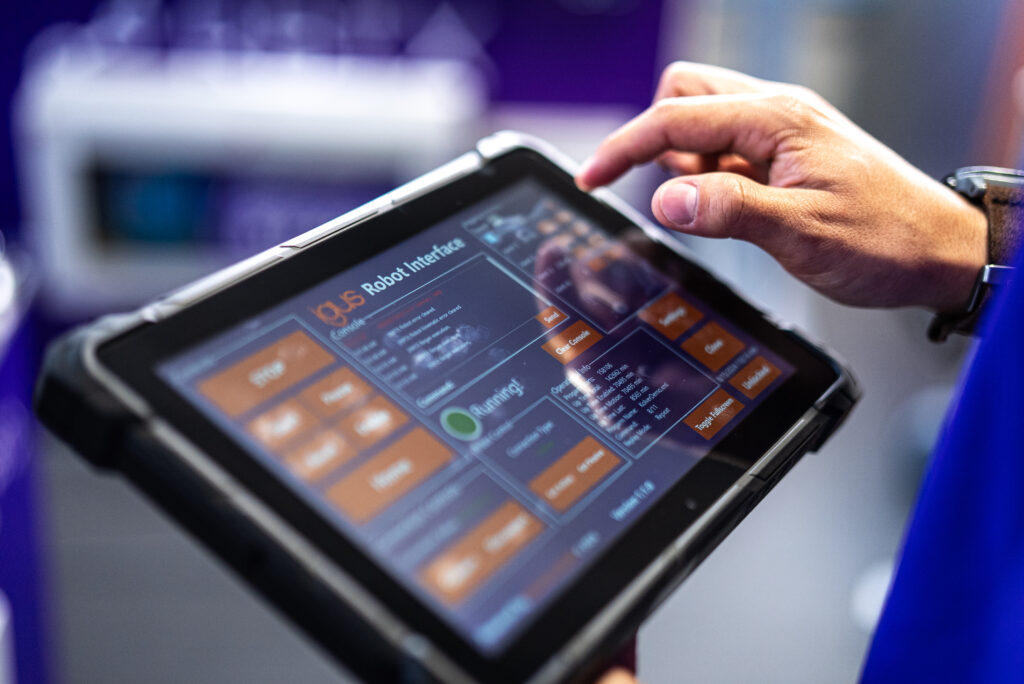
Cobot palletizing systems from vendors including Robotiq, Universal Robots application partners, and Techman Robot have expanded the accessible market for downstream automation by reducing the floor space and capital required for a functional palletizing cell. These systems suit mid-volume consumer goods operations that cannot justify a full industrial palletizing installation but cannot sustain manual palletizing at two shifts.
3. How the Technology Works
Case Sealing and Labeling
Once robotic case packers have loaded products into cartons, case sealers close filled cartons using tape, hot melt glue, or pressure-sensitive adhesive. The choice depends on carton construction, line speed, and cold chain requirements. Hot melt systems seal faster and work in humid environments where tape adhesion fails. Tape systems are simpler to maintain and leave cartons easier to open at the distribution center.
Labeling systems apply shipping labels, barcodes, and compliance markings as cartons pass through the downstream line. Print-and-apply systems print each label on demand from a connected database and apply it in a defined position on the case. This eliminates pre-printed label inventory and ensures that label content reflects the actual production data from the active run rather than a pre-printed batch that may have been staged incorrectly.
Checkweighing and Vision Verification
Checkweighers verify that every case falls within a defined weight tolerance before it proceeds to palletizing. An underweight case indicates a missing product. An overweight case indicates a packing error or foreign material. Either condition is caught automatically rather than discovered at the customer. In regulated industries, checkweigher data is logged per case and retained as part of the batch record.
Machine vision systems downstream of labeling confirm that the label is present, correctly positioned, and readable by barcode scanner before the case is sealed or palletized. Beyond labeling, vision systems verify case closure, cap presence on bottles inside partially open trays, and print quality on inkjet-coded date stamps. In practice, vision verification is the last automated quality gate before the product leaves the facility.
Robotic Palletizing
Robotic palletizers pick filled, sealed, and labeled cases from an end-of-line conveyor and stack them onto pallets in programmed patterns. Six-axis articulated arms handle the widest range of case sizes and pallet configurations. Cobot palletizers suit lighter cases and moderate throughput. Gantry systems suit high-speed single-SKU operations where speed and repeatability matter more than flexibility.
Pallet pattern programming determines how cases interlock on the pallet for stability during transport. Most palletizing systems store multiple patterns and allow operators to select the correct one at changeover through the HMI. Some systems include a pallet dispenser that presents empty pallets automatically, and a pallet conveyor or AMR that removes completed pallets without forklift intervention between cycles.
Stretch Wrapping
Stretch wrappers secure palletized loads for transport by wrapping layers of stretch film around the load in a programmed pattern. Turntable wrappers rotate the pallet while a film carriage moves vertically. Rotary arm wrappers move the film carriage around a stationary pallet, which suits tall or unstable loads that should not rotate. Inline stretch wrapping systems integrate directly into the automated pallet conveyor sequence so completed pallets move from the palletizer to the wrapper to the outbound staging area without forklift handling.
4. The Business Case
The labor cost case for downstream automation centers on palletizing. A fully burdened palletizing position costs $55,000 to $75,000 annually in most U.S. markets. At two shifts, that position costs $110,000 to $150,000 per year. A cobot palletizing system installed at $65,000 to $100,000 pays back in 12 to 18 months at those labor rates. Beyond labor, workers’ comp claims from lifting injuries at palletizing stations frequently exceed $30,000 per incident. A single avoided claim materially improves the ROI calculation.
The quality case centers on verification. Manual checkweighing samples a fraction of production. Automated checkweighing verifies every case. Manual label inspection catches label errors inconsistently. Vision verification catches them at line speed with documented results. In regulated industries, the cost of a label error reaching a customer, including recall, regulatory response, and reputational impact, dwarfs the cost of the vision system that would have caught it.
At scale, the throughput case becomes primary. A palletizing team that can sustain eight pallets per hour at the start of a shift produces six by the end. A robotic palletizer produces eight all shift. That consistency compounds across a two-shift operation into a measurable throughput advantage that does not appear in a per-hour labor comparison but does appear in cases shipped per month.
5. Limitations and Honest Caveats
Downstream automation performs best on consistent product. Case sealers calibrated for one carton construction perform poorly when a different flute grade or blank weight enters the line. Checkweighers require calibration verification across the weight range of every SKU. Palletizing grippers designed for one case size may not reliably handle a significantly different format without tooling changes. High-mix downstream operations require more engineering investment in changeover design than single-SKU lines, and that investment must appear in the project budget.
Stretch wrapping is the step most commonly underspecified in downstream automation projects. Operations that install a robotic palletizer without planning for how completed pallets will move to and from the wrapper create a manual handling gap that offsets a significant portion of the automation return. Plan the full pallet flow from palletizer to wrapper to outbound staging before the project scope is finalized.
Floor space is a genuine constraint in many facilities. A robotic palletizing cell with pallet dispenser, conveyor infeed, safety fencing, and forklift access requires substantially more floor area than the robot footprint suggests. Cobot cells reduce fencing requirements but do not eliminate space needs. Survey the installation zone with all components present in the layout before the capital request is submitted.
6. When It’s a Good Fit vs. Bad Fit
Good fit when:
Downstream automation delivers the clearest return when two or more shifts of manual palletizing, case packing, or stretch wrapping represent a measurable labor cost and a documented injury exposure. At that scale, payback on a cobot palletizer is typically under 18 months and the injury risk reduction carries its own financial justification. Beyond labor, regulated manufacturers who need documented per-case weight and label verification have a compliance-driven case for checkweighing and vision that stands independently of the throughput argument.
High risk when:
The investment carries elevated risk when the upstream packaging machine cannot deliver cases to the downstream line at a consistent rate. A robotic palletizer waiting for cases due to upstream variability does not produce the throughput or labor return projected in the business case. Confirm upstream case output rate and consistency before sizing downstream automation. Beyond that, risk rises when floor space for the full cell, including forklift access and pallet staging, has not been confirmed in the actual facility rather than on a drawing.
Usually the wrong tool when:
Fully automated downstream packaging is the wrong investment for operations with very low volume, extreme case size variability across a shift, or product characteristics that defeat standard vacuum and mechanical grippers without custom tooling investment that exceeds the ROI threshold. In those contexts, ergonomic lift assists, semi-automated stretch wrappers, and manual palletizing with improved station design often produce better returns at lower risk than a full automation installation.
7. Key Questions Before Committing
- What is the fully burdened annual cost of the manual downstream positions being redeployed?
- What is the case output rate from upstream packaging equipment, measured across a full shift rather than at peak speed.
- What is the SKU count and case size range running through the downstream line?
- Has the full pallet flow been mapped from palletizer through stretch wrapper to outbound staging?
- For regulated operations, what are the specific per-case documentation requirements, and have the checkweigher and vision system data outputs been confirmed to satisfy those requirements before equipment selection is finalized?
8. How RBTX Learn Recommends Using This Information
RBTX Learn recommends evaluating downstream automation from the palletizing station outward rather than from the case sealer inward. Palletizing is typically where the highest labor cost, highest injury exposure, and most predictable ROI converge. It is also the step with the most mature and accessible automation technology across a wide range of budgets. Starting there produces payback data that supports the business case for subsequent investment in case sealing, labeling, and verification automation.
On integration planning, treat the downstream sequence as a single system rather than a collection of individual machines. A case sealer that outputs faster than the labeling system can process creates a jam. A palletizer that runs faster than the stretch wrapper can accept completed pallets creates a staging problem. Size every station in the sequence to the same throughput target and confirm that the handoff between stations is designed and documented before any equipment is ordered.
Make sure to confirm floor space and electrical service for the full downstream cell before the capital request is submitted. Most people lose money in the facility preparation work that was not scoped at the time of the equipment decision.