
Dobot CR5A with SafeSkin vs. UR7e: Proximity Sensing or Configured Safety Limits?
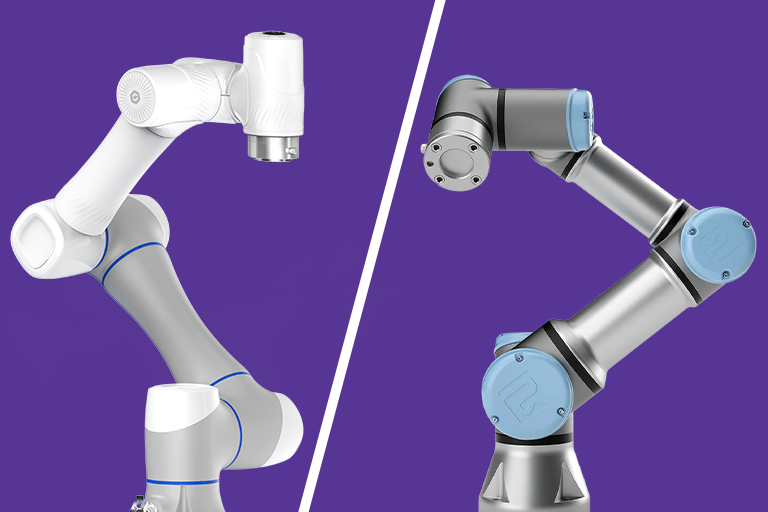
Cobots made up 11% of new industrial robot installations in 2025, according to the IFR, and most of them work within reach of people for at least part of the shift. Two 6-axis cobots on RBTX sit in the same mid-size class: the Dobot CR5A, offered with a SafeSkin proximity-sensing cover, and the Universal Robots UR7e. Both are compliant with PLd category 3 safety standards, both carry an IP54 rating, and both target pick-and-place, packaging, and machine tending.
The real difference lies in how each robot protects a person. SafeSkin wraps the forearm and wrist of the robot in a capacitive sensing layer that detects a hand or body before contact. The UR7e does not sense an approaching person at all. Instead, it holds its joints, elbow, and tool to configured limits on speed, force, power, and position, and stops when one is exceeded. One design stops before contact, while the other keeps contact tolerable.
Below, the two approaches go head-to-head on sensing coverage, stopping behavior, collaborative speed, tool hazards, integration, and cost. The comparison closes with the cases where proximity sensing pays for itself and the safeguarding neither robot can skip.
RBTXpert Debrief: What are Automation Guarding Safety Standards, and What Does Hardware Look Like?
The Two Robots at a Glance
| Specification | Dobot CR5A with SafeSkin | Universal Robots UR7E |
|---|---|---|
| Max. payload | 5 kg | 7.5 kg |
| Max. reach | 900 mm | 850 mm |
| Repeatability | ±0.02 mm | ±0.03 mm |
| Arm weight | 25 kg | 20.6 kg |
| Max. speed | 4 m/s | 4 m/s |
| Protection rating | IP54 | IP54 |
| Safety | PLd Category 3; 20+ safety functions | PLd Category 3; 23 configurable safety functions |
| Approach detection | SafeSkin, up to 15 cm from the cover | None built in |
| Teach pendant | Optional add-on | Included |
How Does SafeSkin Proximity Sensing Work?
SafeSkin is a silicone wrap with built-in capacitive sensing. On the CR5A, Dobot fits four SafeSkin modules — one on the forearm and one each on joints 4, 5, and 6. Each module watches for conductive objects such as a hand, arm, or metal part. Its field extends 5–15 cm from the surface, giving the arm warning before contact, with range depending on where the module sits. Dobot lists a 0.01 s detection cycle and a full stop within 0.1 s.
When the obstacle clears, SafeSkin can resume the program without operator input, and Dobot also describes avoidance moves instead of a hard stop. The CR5A’s standard safety system still runs underneath: five collision-detection sensitivity levels, TCP force, power, and momentum limits, virtual safety zones, and 10 dual-channel safety I/O channels. SafeSkin adds a sensing layer rather than replacing that controller.
How Do the UR7e’s Configured Safety Functions Work?
The UR7e monitors itself rather than its surroundings. Its safety system tracks joint positions and speeds, TCP and elbow speed, and the force the tool and elbow can exert. It also watches robot power and momentum, tool orientation, and stopping time and distance. Integrators set each limit in PolyScope, and safety planes fence the tool and elbow out of defined zones in the cell. Universal Robots rates these functions and the safety I/O to PLd, Category 3.
A limit violation triggers a stop. Safety inputs from a light curtain, door switch, or laser scanner can also trigger a protective stop. They can instead switch the robot into reduced mode, which applies a tighter set of limits. Because none of this senses approach, the robot learns about a person at the moment of contact — or when an external sensor tells it.
Sensing Coverage and Limitations
SafeSkin only senses where it is installed. The base, shoulder, and upper arm carry no modules on the CR5A, and nothing covers the gripper, the tool, or the part, so coverage stops where the silicone stops. That leaves the tool tip — often the closest point to a hand at a workbench — outside the sensing field.
Capacitive sensing also depends on what approaches. Dobot rates SafeSkin for human bodies, metals, and liquids and says gloves and clothing do not block detection. It also notes reduced effectiveness on non-conductive items, so a plastic tote or cardboard case can reach the arm undetected. Metal fixtures, chucks, and parts near the wrist are conductive, which means path planning has to keep them outside the field or accept nuisance stops. Detection range also varies by module location, so the field has to be verified in the finished cell rather than taken from a data sheet.
The UR7e’s limits cover the whole arm, plus the tool once its geometry is entered, because they act on the robot’s own motion. They cannot detect a person standing in the path. The robot responds to contact through its force limit, and any earlier warning has to come from a device wired to its safety inputs.
Stopping Behavior
SafeSkin aims to stop before contact, but the sensing field is only centimeters deep. The arm keeps moving during its 0.1 s stop, and a person walking toward it closes the gap at the same time. As a result, the faster the arm moves, the less margin remains when it finally halts. That is why Dobot ties its speed figures to tested conditions and a risk assessment.
The UR7e’s stops follow configured limits. Exceeding a speed or force limit triggers a stop. The stopping time and stopping distance functions also cap how long and how far the arm travels once a protective stop begins. Those limits give integrators a fixed value to design scanner separation distances around.
The trade-off is clear: SafeSkin spends a small sensing margin to avoid contact, while the UR7e accepts limited contact in exchange for predictable, configurable stopping.
Collaborative Speed
Under power and force limiting, robot speed near people is capped by how much force and pressure a body region can absorb on contact. Lab measurements on cobots have found safe contact speeds far below rated TCP speed, and those limits change with where in the workspace contact happens. Slow collaborative speed is the main cycle-time cost of building a cell around tolerable contact.
Dobot positions SafeSkin as a way past that ceiling. The RBTX listing gives a maximum human-robot interaction speed of 1 m/s with SafeSkin. Dobot bases that figure on its own lab tests and conditions it on a risk assessment. The gain only applies where the arm links are the contact hazard; if the tool can reach a person, tool speed still has to satisfy power and force limits.
The UR7e reaches speed by another route. When an area scanner or light curtain shows the shared zone is empty, the robot runs at full programmed speed — up to 4 m/s at the TCP. As someone enters, it drops into reduced mode. That layout keeps full speed available whenever the zone is clear, at the cost of extra hardware and floor space.
What About Tooling Hazards?
Neither robot’s built-in safety makes a sharp, hot, or pinching tool safe. A screwdriver bit, dispensing needle, blade, or gripper finger concentrates force into a small area. As a result, contact pressure can exceed safe values even while contact force stays within the robot’s limit. The end effector often sets the speed limit for the whole cell.
Dobot’s documentation places SafeSkin modules on the arm, not the end effector, so the tool tip sits outside the sensing field. The UR7e can include the tool in its force limit and safety planes once the TCP and tool geometry are configured. That restricts where the tool goes but still treats contact as acceptable. Gripper clamping force is a separate hazard on both robots. An electric or pneumatic gripper can pinch a finger with force the arm never measures, so grip force and behavior on power loss need their own assessment.
Practical fixes include shrouding or retracting the tool, slowing down when it points toward an operator, and using soft grippers where people work within reach.
Integration Effort
The UR7e ships with its teach pendant and runs PolyScope 5 or PolyScope X. Its safety inputs, PROFIsafe support, and reduced-mode switching make it simple to wire scanners, light curtains, and door switches. Third-party suppliers also sell safety scanner kits that configure directly from the pendant.
The CR5A programs through DobotStudio Pro with block-based programming or Lua scripts. It connects over Modbus, EtherNet/IP, PROFINET, and ROS, and offers 10 dual-channel safety I/O channels for the same external devices. SafeSkin adds two integration tasks: validating detection range in the actual cell, and routing cables and hoses so the dress pack does not cover the modules. On RBTX, the CR5A teach pendant is a separate add-on.
How Does Each Compare on Cost?
On list price, Dobot’s CRA platform generally sits below Universal Robots’ e-Series in this payload class ($23,350 vs. $38,363), and the SafeSkin variant carries a premium over the standard CR5A ($25,810). The UR7e price includes its teach pendant; the CR5A price does not.
Arm price is only part of the bill: grippers, fixtures, risk assessment, validation, and any scanners or guarding land on top of it. SafeSkin pays off when it removes a scanner or lets the cell run faster near people. If the application still needs area sensing because of the tool or payload, the premium buys less.
When Does Proximity Sensing Add Practical Value?
SafeSkin earns its premium where people move around the arm often and the arm links, not the tool, are the main contact hazard:
- Shared benches with frequent, unplanned access: operators reach in to swap trays or clear parts, and a scanner-triggered stop would interrupt the cell constantly.
- Cycle-time pressure under power and force limiting: the task runs too slowly at contact-tolerant speeds but does not justify a fenced or scanned cell.
- Benign tooling: suction cups, soft grippers, and light parts keep the end effector out of the hazard picture.
- Tight floor space: the bench has no room for scanner fields or light-curtain safety distances.
Proximity sensing adds less when the tool is the dominant hazard, when non-conductive objects need detecting, or when metal fixtures crowd the wrist. For cells that must run well above 1 m/s with people nearby, a scanner-based speed and separation layout is the better fit.
What Safeguarding Does the Application Still Require?
A collaborative robot does not make a collaborative application. ISO 10218-2, revised in February 2025, covers robot applications and cells and now carries most of the collaborative-application requirements first set out in ISO/TS 15066. Whichever robot you choose, the cell still needs:
- A documented risk assessment: every task, tool, part, and person who enters the space, following ISO 12100 and ISO 10218-2.
- Measured contact forces and pressures: for any power and force limiting zone, tested with the real tool and part rather than calculated from the data sheet.
- Tool and gripper safeguarding: shrouds, reduced speed, or exclusion zones for anything sharp, hot, or pinching, plus a check of gripper behavior on power loss.
- Stops and enabling devices: emergency stops within reach and a three-position enabling device for teaching.
- External sensing where the hazard calls for it: scanners, light curtains, or interlocked guards wired to the robot’s safety inputs.
- Revalidation after changes: a new tool, part, payload, or layout reopens the assessment.
SafeSkin can reduce how often contact appears in that assessment, but it does not remove the assessment. Dobot says the same in its own SafeSkin documentation.
Which Robot Fits the Job?
| Factor | Edge | Why |
|---|---|---|
| Approach detection | CR5A with SafeSkin | Senses conductive bodies before contact on the forearm and wrist |
| Arm and tool coverage | UR7e | Configured limits act on every joint, the elbow, and the configured tool |
| Collaborative speed near the arm | CR5A with SafeSkin | Dobot rates SafeSkin-assisted interaction up to 1 m/s, subject to risk assessment |
| Predictable stopping | UR7e | Stopping time and distance are configurable, monitored limits |
| Tool hazards | Neither | Both need tool guarding, reduced speed, or exclusion zones |
| Payload | UR7e | 7.5 kg vs. 5 kg |
| Reach | CR5A with SafeSkin | 900 mm vs. 850 mm |
| Safety accessory ecosystem | UR7e | Pendant included; broad range of third-party safety scanner kits |
| Arm list price | CR5A with SafeSkin | $25,810 vs. $38,363 |
Choose the CR5A with SafeSkin when people work around the arm often, the tool is benign, and cycle time suffers at contact-tolerant speeds. Choose the UR7e when the cell will rely on configured limits plus external sensing, needs the extra payload, or benefits from an established safety-accessory ecosystem. Both robots are available on RBTX, and a free RBTXpert video call can help scope the safeguarding before you commit to either.