
Hot Melt Adhesive Automation: What Makes It Different and How to Get It Right
1.What This Covers and Why It Matters
Hot melt adhesive behaves differently from every other material used in automated dispensing systems in manufacturing. It arrives as a solid, transitions to a liquid under heat, dispenses in that liquid state, and solidifies on the substrate within seconds of contact. There is no cure reaction, no moisture dependence, no pot life, and no mix ratio. The viscosity is controlled entirely by temperature rather than chemistry. That single difference makes hot melt both simpler and more demanding than cold adhesive systems in ways that are not obvious until a cell is running in production.
Hot melt is everywhere. Packaging lines use it to seal cartons and apply labels. Furniture manufacturers use it to bond edge banding and assemble cabinet components. Product assembly operations use it for foam bonding, filter element sealing, and bookbinding. Automotive interior suppliers use it for headliner lamination and door panel assembly. The global hot melt adhesive market exceeded $8 billion in 2024 and continues growing, driven by its fast set speed, absence of solvents, and compatibility with high-speed automated production.
2.Typical Equipment in This System
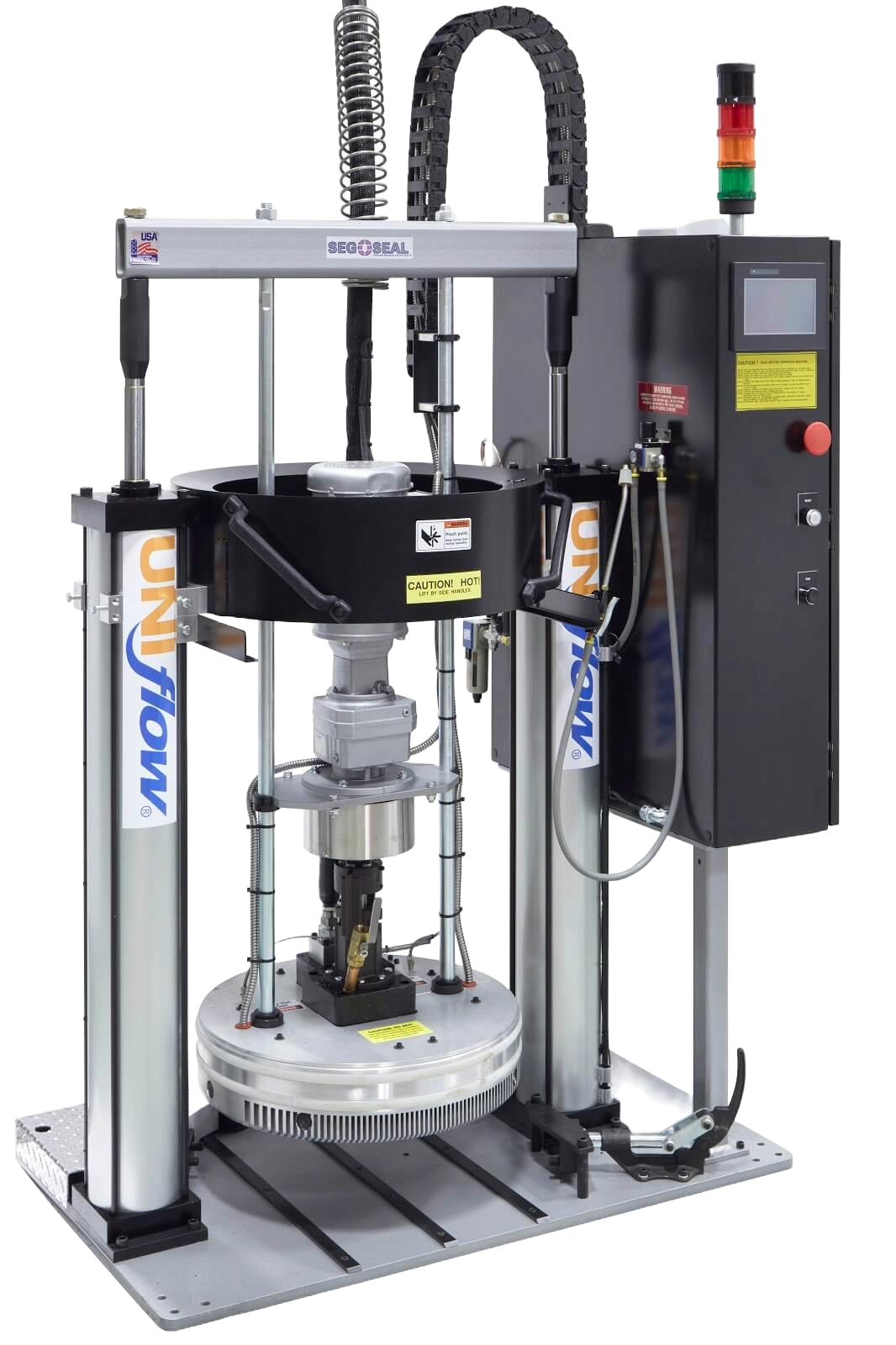
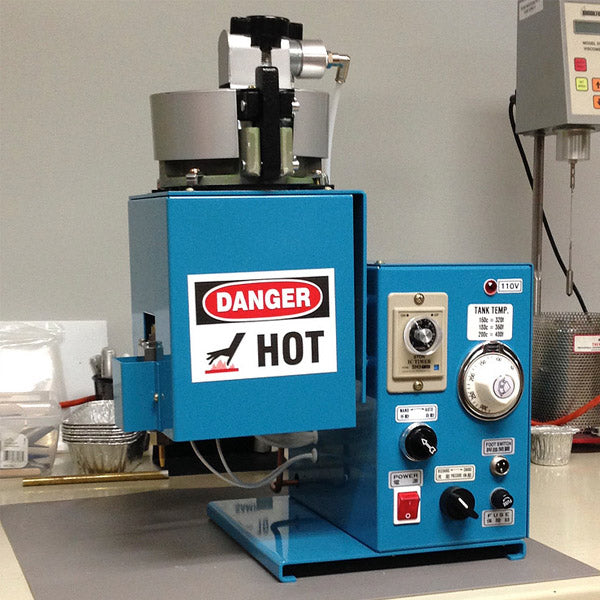
| Equipment | Role or Typical Capability |
|---|---|
| Hot melt melter or tank | Melts solid adhesive from pellet, block, or drum form; maintains molten material at target temperature; Nordson, Graco, and Robatech supply the dominant industrial melter lines |
| Heated hose | Carries molten adhesive from melter to applicator head at consistent temperature; hose temperature typically set 5 to 10°C below melter temperature to prevent degradation |
| Applicator head or gun | Controls dispensing through pneumatic or electric valve; slot nozzles, bead nozzles, and spray heads all available depending on application pattern |
| Temperature controller | Maintains consistent temperature across melter, hose, and applicator head; PID controllers on each zone prevent temperature variation that would change viscosity |
| Char filter or strainer | Captures degraded adhesive particles that would otherwise clog nozzles; replaced on a maintenance schedule |
| Pressure relief and monitoring | Monitors supply pressure continuously; pressure drops signal low adhesive level or blockage; pressure spikes signal clogged nozzle or filter |
3.How It Works
Temperature Controls Everything
Hot melt viscosity responds to temperature in a direct and steep relationship. Higher temperature produces lower viscosity and faster flow. Lower temperature produces higher viscosity, slower flow, and at some point, a solid that will not dispense at all. For most ethylene-vinyl acetate based hot melts, the operating temperature range runs from 150°C to 190°C. Polyurethane reactive hot melts run hotter and carry isocyanate exposure hazards that require dedicated chemical safety planning. Metallocene-based hot melts for sensitive substrates may run cooler.
The practical consequence of this relationship is that temperature variation across the system directly produces bead volume variation at the nozzle. A melter running 5°C hotter than its setpoint dispenses more material per shot than the program expects. A hose that loses 10°C between the melter outlet and the applicator head produces a narrower bead than the one the operator calibrated. Nordson’s melter and hose systems use independent PID temperature control on every heated zone for exactly this reason. Each zone holds its setpoint within ±1°C to prevent the viscosity variation that temperature drift introduces.
Char and Degradation: The Hidden Enemy of Hot Melt Cells
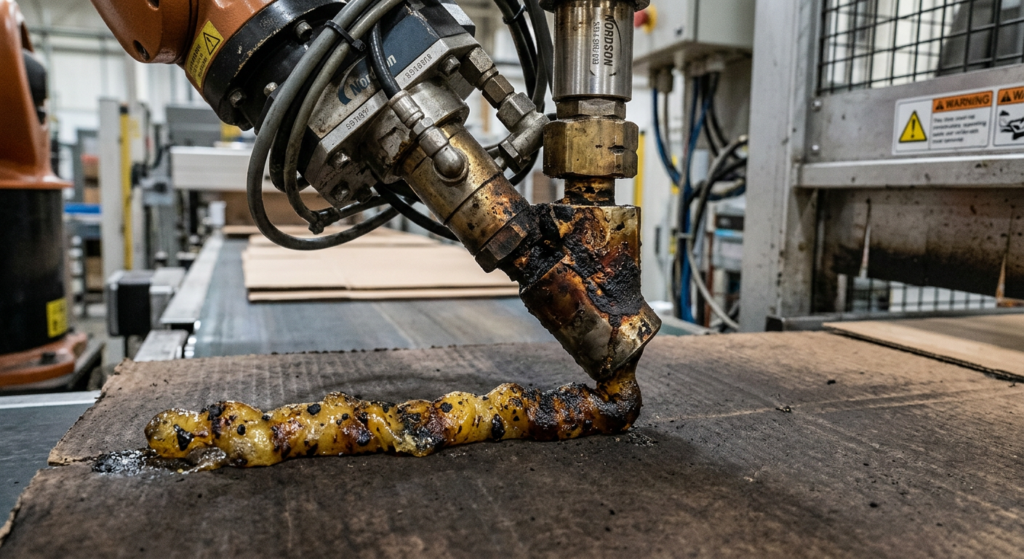
Hot melt adhesive degrades when held at elevated temperature for extended periods. The polymer chains break down and form char, which appears as dark specks or strings in the dispensed bead. Char contaminates the substrate and, more significantly, clogs nozzle orifices and filter screens. A clogged nozzle changes the dispense pattern without generating an alarm, producing bead defects that may not surface until downstream inspection.
Degradation rate varies with temperature and dwell time. Keeping the melter at the minimum temperature that produces adequate flow reduces char formation significantly. Graco’s InvisiPac system uses a demand-based melting approach to address this directly: rather than maintaining a large tank of molten adhesive at temperature continuously, the system melts only as much material as the production line demands. On packaging lines running Henkel Technomelt or HB Fuller hot melt formulations, InvisiPac reduces char-related maintenance substantially compared to traditional tank melters running at continuous high temperature between production shifts.
Set Speed and Open Time
Hot melt bonds form as the molten adhesive contacts the substrate and begins cooling. The bond reaches handling strength within 1 to 30 seconds depending on adhesive formulation, substrate thermal mass, and ambient temperature. This fast set speed is one of hot melt’s primary production advantages. Packaging lines running at 100 to 300 cartons per minute depend on hot melt setting fast enough that the sealed carton reaches the downstream conveyor with bond integrity already established.
Open time is the window between dispensing and substrate contact during which the adhesive remains hot enough to wet the second surface. If the assembly sequence takes longer than the open time allows, the adhesive skins over and the bond fails. Open time varies from under a second for very fast-set packaging hot melts to 60 seconds or more for assembly applications where positioning requires more time. Selecting the correct formulation for the assembly sequence timing is as important as selecting the correct temperature setpoint.
4.Industry Applications
Packaging: The Highest-Volume Hot Melt Application
Packaging is where hot melt dominates. Carton sealing, tray forming, and label application on food, beverage, consumer products, and e-commerce fulfillment lines all run hot melt at high speed. Nordson’s ProBlue and Freedom series melters are standard equipment on packaging lines worldwide. Henkel’s Technomelt and HB Fuller’s Swift series are among the most widely used adhesive formulations for carton sealing.
A high-speed carton sealing line running 200 cartons per minute applies hot melt through slotted nozzles at the bottom and top flap seals, with each application taking less than 100 milliseconds. Temperature management at this cycle rate requires consistent melter output, heated hoses without thermal gradient, and nozzle orifices clean enough to maintain consistent flow. A single partially clogged nozzle on a line running at that speed seals hundreds of defective cartons before the defect is detected if inline inspection is not present.
Woodworking and Furniture: Edge Banding and Panel Assembly
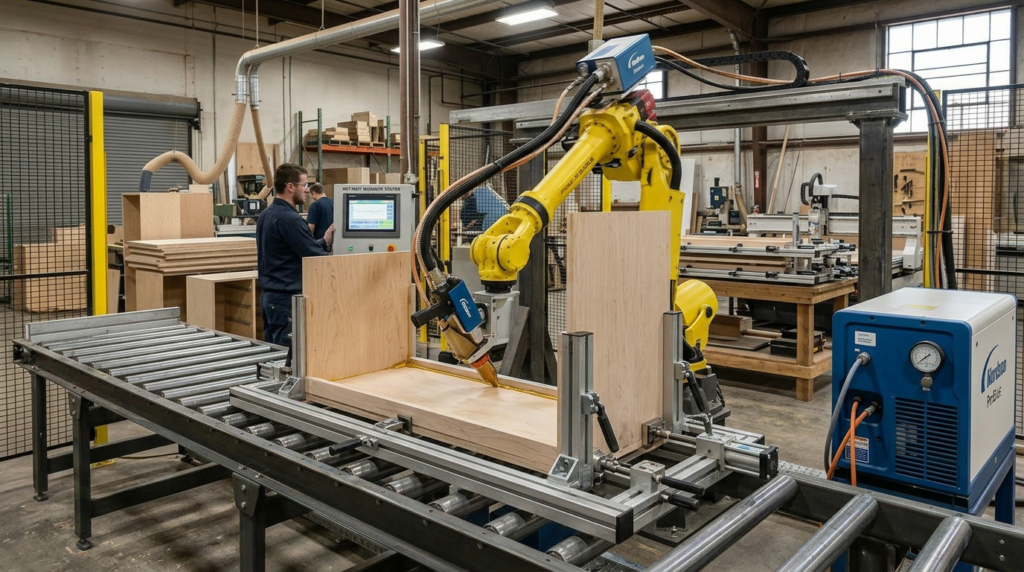
Edge banding in cabinet and furniture manufacturing is one of the most demanding hot melt applications in terms of substrate adhesion requirements and aesthetic quality. The adhesive bonds PVC, ABS, or wood veneer edge tape to the exposed edges of MDF and particle board panels. Holz-Her and Biesse edge banding machines integrate hot melt applicator systems that apply adhesive to the panel edge at feed speeds of 15 to 25 meters per minute. Jowat’s Jowapur reactive polyurethane hot melt is widely specified for high-moisture environments including kitchen cabinets and bathroom furniture because it crosslinks after bonding to produce a waterproof bond that standard EVA hot melt cannot match.
The critical process variable in edge banding is temperature uniformity across the full panel edge width. Cold spots produce adhesion failure at the edges of the tape. Hot spots produce adhesive squeeze-out that requires cleanup and may cosmetically damage the panel face. Maintaining ±2°C across the applicator head width is the standard specification on precision edge banding lines.
Product Assembly: Automotive Interiors and Filter Manufacturing
Automotive interior suppliers use hot melt for headliner lamination, door panel fabric bonding, and foam-to-substrate assembly. H.B. Fuller’s HL series hot melts are specified extensively in European and North American automotive interior assembly for their low-odor, low-VOC profiles that comply with OEM interior air quality specifications. Graco’s Liquid Control and Robatech’s Concept series applicators handle the slot-coating and bead applications used in these assembly operations.
Filter manufacturing uses hot melt to bond end caps onto filter media, seal pleated paper into housings, and attach gaskets to filter frames. Donaldson, Mann+Hummel, and Parker Hannifin all run automated hot melt dispensing on filter assembly lines. The application requires consistent bead geometry around complex perimeter paths, which is why 6-axis robots with heated end-of-arm tooling have replaced fixed gantry dispensing systems on high-mix filter assembly cells. The robot adapts to different filter geometries through program changes rather than tooling changes, reducing changeover time significantly.
5.Common Failure Modes and Constraints
| Failure | Root Cause | Signal or Symptom |
|---|---|---|
| Stringing between application points | Temperature too high; viscosity too low; inadequate snuff-back | Adhesive strings across substrate between beads; contamination of bond area |
| Bond failure at substrate | Open time exceeded before assembly; substrate too cold for adequate wetting | Bond peels cleanly at adhesive-substrate interface; no adhesive transfer to second surface |
| Nozzle clogging or irregular bead | Char accumulation in nozzle orifice; filter screen bypassed or missing | Bead width variation; intermittent flow interruption; dark specks in dispensed material |
| Adhesive dripping at idle | Temperature too high; nozzle valve not sealing adequately | Adhesive drops onto conveyor or substrate between production cycles |
| Inconsistent bead volume across shift | Temperature drift in heated hose or applicator head; thermocouple failure | Bead progressively narrower or wider; volume variation without pattern change |
| Substrate scorching or damage | Temperature too high for substrate material; dwell time too long at contact | Discoloration on paper, film, or foam substrates; adhesion damage to surface |
Stringing is the failure that generates the most production interruptions on high-speed lines because adhesive strings transfer to conveyor surfaces, accumulate on machine components, and eventually cause jams. The root cause is almost always temperature set too high for the application. Reducing the melter temperature by 10°C and confirming that snuff-back vacuum is correctly set on the applicator valve resolves most stringing problems without requiring equipment changes.
6.Good Fit vs. Bad Fit
Good fit when:
Hot melt is the right choice for high-speed assembly where set speed within seconds is required, for applications where solvent-free chemistry is a production or regulatory priority, and for operations where simplified cleanup between runs and no pot life management represent meaningful production advantages. Packaging lines, woodworking and furniture assembly, and high-volume product assembly operations running clean-room or food-contact environments all fit this profile well.
High risk when:
Hot melt carries risk on substrates sensitive to heat. Thin films, foil laminates, foam materials with low melting points, and heat-sensitive electronics components can all be damaged by adhesive temperatures above 150°C. Test adhesive contact on representative substrates before committing to hot melt for any heat-sensitive application.
Usually the wrong tool when:
Hot melt is inappropriate for structural load-bearing bonds that must survive elevated service temperatures. Most EVA-based hot melts soften above 60°C to 80°C under sustained load, which means they creep and eventually fail on joints exposed to warm environments. Structural applications requiring service above 60°C or sustained peel loads should use two-part epoxy or structural acrylic systems rather than hot melt.
7.Key Questions Before Committing
- What is the substrate’s heat tolerance, and has the adhesive temperature been confirmed as safe for direct contact with the specific substrate materials at the dwell time the production sequence produces?
- What is the required open time for the assembly sequence, and does the selected formulation’s open time match the assembly timing window at the facility’s ambient temperature range?
- What is the melter system’s approach to char management, specifically whether it uses demand-based melting or continuous-tank melting, and does that approach match the production line’s duty cycle?
- What is the maintenance schedule for nozzle cleaning and filter replacement, and has that schedule been built into the cell’s planned maintenance program rather than deferred to symptom-driven intervention?
- For structural or moisture-exposed applications, has reactive polyurethane hot melt been evaluated against standard EVA formulations, and does the production sequence accommodate the secondary moisture-cure that reactive PUR requires?
8.How RBTX Learn Recommends Using This Information
RBTX Learn recommends selecting hot melt adhesive formulation and operating temperature simultaneously rather than selecting the adhesive first and then dialing in temperature during commissioning. The formulation determines the correct temperature range. The temperature range determines equipment specification. Starting with the formulation decision produces a correctly specified system. Starting with temperature and adjusting the formulation later produces a system optimized for the wrong material.
On char management, build a nozzle and filter maintenance interval into the cell controller as a cycle-count trigger rather than relying on operator observation of bead quality degradation. Char builds slowly enough that operators normalize the gradual quality change. A cycle-count maintenance trigger catches the interval before char reaches the nozzle regardless of what the bead looks like.