
Types of Humanoid Robots in 2026: A Breakdown by Form Factor and Mobility Architecture
1. What This Resource Covers & Why It Matters
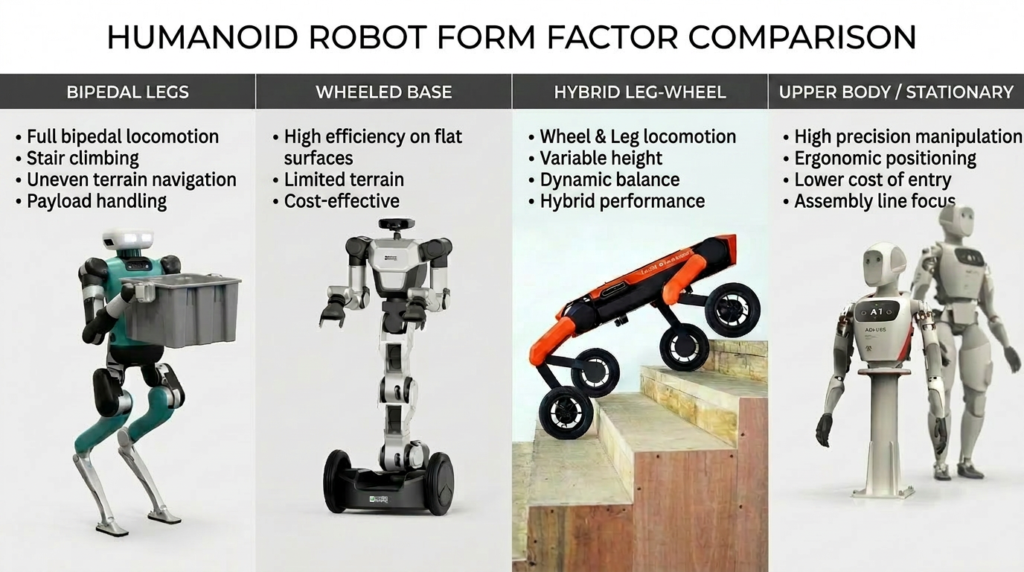
The term “humanoid robot” covers a wider range of machines than most people realize. Some walk on two legs. Others roll on wheels. A few combine both. And some have no legs at all. For engineers and automation managers evaluating this technology, understanding the form factor differences is more useful than comparing brand names, because form factor determines where a robot can actually work.
This article breaks down the main humanoid robot architectures in active development and deployment as of 2026. It covers bipedal, wheeled, hybrid, and upper-body-only configurations, with a focus on what each architecture does well and where each falls short. The goal is to give decision-makers a clear framework before they engage vendors or evaluate proposals.
This article does not cover fully autonomous capability comparisons or AI platform benchmarks. Those change quickly and require per-application validation. The focus here is architecture and mobility, not software.
2. Typical Equipment in This System
| Equipment | Role or Typical Capability |
|---|---|
| Bipedal legs with active balance control | Navigate stairs, ramps, and uneven terrain; require continuous power to maintain stability |
| Wheeled base (single or multi-wheel) | Flat-surface mobility; more energy-efficient than legs; stable when powered off |
| Hybrid leg-wheel drivetrain | Combines rolling on flat surfaces with leg-based terrain adaptation |
| Dexterous multi-finger hand | Object manipulation, tool use, and fine assembly tasks |
| Onboard vision system (cameras + depth sensors) | Environment perception, object recognition, navigation |
| AI inference hardware (onboard) | Real-time motion planning, perception processing, task execution |
| Battery and power management system | Determines operating duration; typically 3–5 hours per charge on current platforms |
| Fleet management software | Coordinates multiple units, monitors status, manages task assignment |
3. How It Works: Real-World Breakdown
Full Bipedal Architecture
Bipedal robots walk on two legs using active balance control algorithms that compensate continuously for gravity, load shifts, and terrain variation. Tesla Optimus Gen 2, Figure 02, Agility Robotics Digit, and Boston Dynamics Atlas all use this architecture. The strategic advantage is clear: bipedal robots can navigate any environment a human can. They use existing stairs, doorways, ramps, and workstations without facility modification.
In practice, this advantage comes with trade-offs. Bipedal robots require constant power to stay upright. A power failure causes them to fall. They also generate vibration during walking, which matters when transporting sensitive components. Beyond that, battery life on current platforms runs three to five hours, which limits unattended shift coverage. Even so, for brownfield deployments in facilities already built for humans, bipedal architecture removes the facility redesign cost that traditional automation requires.
Wheeled Humanoid Architecture
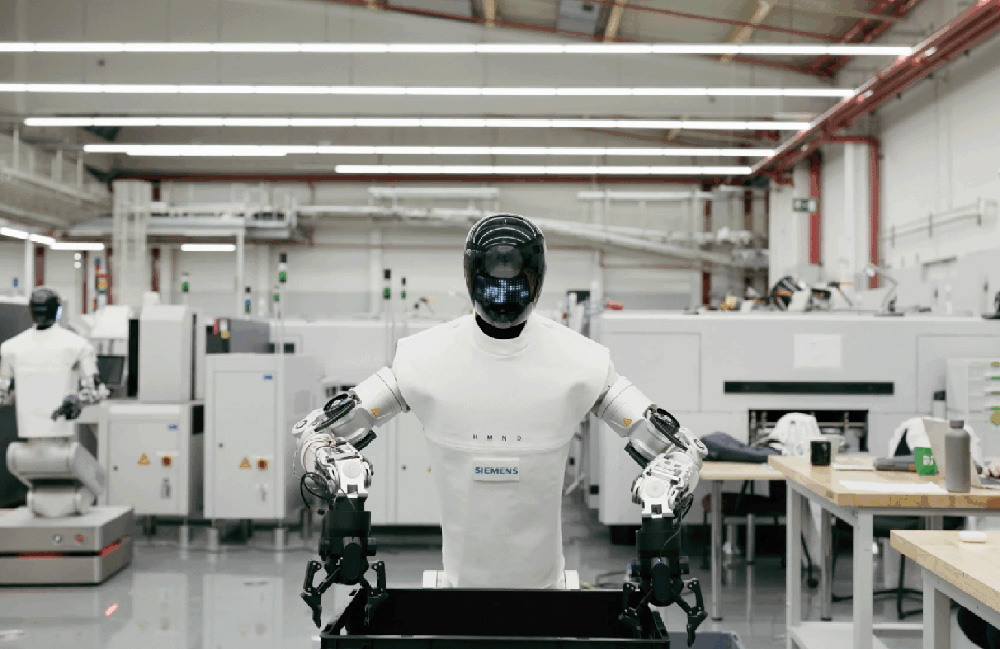
Wheeled humanoids mount a human-like upper body on a motorized base. SoftBank’s Pepper and several emerging industrial platforms use this approach. The trade-off is deliberate: wheels sacrifice stair-climbing ability for meaningful gains in energy efficiency, stability, and flat-surface speed. In practice, wheeled platforms outperform bipedal systems on cost-per-task metrics in flat environments like factory floors, logistics facilities, and retail spaces.
More importantly, wheeled robots remain stable when powered down. That matters for safety in shared workspaces. A wheeled platform that loses power sits still. A bipedal platform that loses power falls. For operations running on flat, single-level floors, the wheeled architecture delivers the dexterous upper-body capability of a humanoid without the complexity and risk of active balance control.
Hybrid Leg-Wheel Architecture
Hybrid designs combine a wheeled base with articulated legs or leg-like structures that allow the robot to adapt to minor terrain variation while still using wheels as the primary locomotion mode. Guangzhou Auto Group’s GoMate and several Chinese platforms take this approach. The result is a robot that rolls efficiently on flat surfaces but can handle ramps, small steps, and uneven floor transitions that would stop a purely wheeled system.
This architecture represents a practical engineering compromise. In practice, most factory and warehouse floors do not require full stair-climbing capability. They do, however, have loading dock ramps, floor transitions between zones, and uneven surfaces near machinery. A hybrid platform handles those obstacles while preserving the energy efficiency and stability advantages of wheels on clean flat surfaces.
Upper-Body-Only and Stationary Platforms
Some humanoid platforms have no mobility component at all. These upper-body systems mount to a fixed post or rail and focus entirely on dexterous manipulation. They are common in structured assembly cells, research labs, and proof-of-concept deployments where mobility is not required. In those contexts, eliminating the mobility system reduces mechanical complexity and cost significantly. The trade-off is obvious: these systems cannot move between workstations or navigate a facility. For that reason, stationary platforms suit high-value, fixed-location tasks rather than general-purpose floor deployment.
4. Integration & Deployment Reality

Architecture choice directly affects integration complexity. Bipedal systems introduce fall risk planning into every deployment. The floor plan must account for what happens if the robot loses balance near equipment, shelving, or human workers. ISO 25785-1, the emerging standard for industrial mobile robots with actively controlled stability, addresses this but is not yet finalized. Until it is, evaluate bipedal deployments against general ISO 10218 machinery safety requirements and define the fall response protocol before go-live.
Wheeled systems integrate more like advanced AMRs. The fleet management layer, charging infrastructure, and navigation map setup follow familiar patterns for operations already running autonomous mobile robots. In contrast, bipedal systems require terrain mapping that includes obstacle height, surface texture, and slope data, not just floor layout. That mapping step takes longer and requires more validation.
Vendor documentation for any humanoid platform covers the robot’s operating specifications. It does not cover how the platform integrates with a facility’s PLC, MES, or safety monitoring system. That integration is entirely the team’s responsibility and deserves dedicated engineering time before deployment begins.
5. Common Failure Modes & Constraints
Mobility Failures
| Failure | Root Cause | Signal / Symptom |
|---|---|---|
| Bipedal fall event | Power loss, balance algorithm failure, or unexpected surface condition | Robot collapses; may damage equipment or injure nearby workers |
| Wheeled platform navigation fault | Obstacle outside map, floor surface change | Robot stops mid-route; requires operator restart |
| Hybrid terrain negotiation failure | Ramp angle or surface texture outside validated envelope | Robot halts at transition; cannot proceed autonomously |
Bipedal fall events are the most consequential failure mode in humanoid robot deployments. Current platforms weigh between 50 and 90 kilograms. A fall at that weight can cause serious equipment damage and worker injury. In practice, most current bipedal deployments operate in areas cordoned off from human workers during active operation. Design the workspace layout and safety zone before specifying the robot, not after.
Perception and Task Failures
| Failure | Root Cause | Signal / Symptom |
|---|---|---|
| Object grasp failure | Lighting variation or surface reflectivity confuses vision model | Robot misses pick; retries until fault threshold reached |
| Task drift over shift | Battery level degradation affects actuator performance | Increasing error rate in the second half of a shift |
| Navigation map invalidation | Physical environment changes since last map update | Robot stops at unexpected obstacle; cannot route around |
6. When It’s a Good Fit vs. a Bad Fit
Good fit when:
Bipedal architecture fits when the deployment environment has multiple floor levels, stairs, ramps, or terrain variation that a wheeled system cannot handle. The form factor also fits when the facility cannot be modified and the robot must use existing infrastructure as-is. In those cases, the added complexity of active balance control is justified by the access the legs provide.
Wheeled architecture fits when the environment is flat, single-level, and consistent. In that context, wheels deliver better energy efficiency, longer operating time, and simpler safety management than legs. For the majority of factory and warehouse floor deployments, a wheeled humanoid provides the dexterous upper-body capability that differentiates humanoids from fixed robot arms, without the fall risk of a bipedal system.
High risk when:
Any humanoid architecture becomes high risk when the task population is broad, exceptions are frequent, or the robot must make real-time judgments about novel situations. The form factor alone does not confer general intelligence. Beyond that, bipedal deployments in shared human workspaces carry elevated risk until ISO 25785-1 provides clearer safety certification guidance.
Usually the wrong tool when:
A structured, fixed manufacturing cell running a single repeatable task does not need a humanoid. A purpose-built industrial robot arm or cobot handles that task more reliably, at lower cost, and with better-defined safety characteristics. Reach for a humanoid when the mobility or form factor solves a specific problem that fixed automation cannot. Do not reach for it because it is new.
7. Key Questions Before Committing
- Does the deployment environment have stairs, ramps, or terrain variation that requires bipedal mobility, or is the floor flat and single-level? That single question largely determines the architecture.
- What is the expected operating duration per shift, and does the platform’s battery life support that requirement with margin for charging cycles?
- How does the platform handle a power loss event, and has the fall or stop response been assessed against the facility’s safety requirements and the ISO 25785-1 draft standard?
- What terrain mapping does the platform require, and who owns that mapping process and its ongoing maintenance as the facility layout changes?
- What is the total system cost over three years, including hardware, integration, charging infrastructure, maintenance contracts, and the internal engineering time to manage the deployment?
8. How RBTX Learn Recommends Using This Information
RBTX Learn evaluates humanoid robot architecture decisions by starting with the environment, not the platform catalog. Define the floor plan, identify every terrain transition the robot must navigate, and map the locations where humans will work during robot operation. That environmental assessment determines which mobility architecture is viable before any vendor conversation begins.
For most industrial facilities evaluating a first humanoid deployment in 2026, We recommend the wheeled or hybrid architecture over full bipedal unless stairs or significant terrain variation are present. Wheeled platforms are deploying reliably in logistics and manufacturing environments now. They integrate more predictably, carry lower fall risk, and operate longer per charge. In that context, they deliver the practical value of humanoid upper-body dexterity without the unresolved safety and reliability challenges that bipedal systems still carry in shared workspaces.
The architecture landscape will continue to shift as battery technology improves, balance algorithms mature, and safety standards finalize. We recommend treating the current architecture choice as a deployment-specific decision, not a long-term platform commitment, and ensuring contract terms allow hardware transitions as the technology evolves.
Sources & Further Reading
This report was informed by publicly available industry material, including:
- Proven Robotics – Types of Humanoid Robots
https://provenrobotics.ai/types-of-humanoid-robots - Humanoid Robotics Technology – Top 12 Humanoid Robots of 2026
https://humanoidroboticstechnology.com/articles/top-12-humanoid-robots-of-2026/ - Wallpaper – Overview of Emerging Humanoid Robots
https://www.wallpaper.com/tech/humanoid-robots
Full credit for original research and reporting belongs to the respective authors and organizations.